Sunday, July 14, 2013

Réunion July 2013, La Roche Ecrite

This is The site in Réunion for birders, for it is the only place in the world, where all land endemics of Réunion can be seen. Most of these can be seen throughout the entire island, but Reunion Cuckooshrike is confined to this single mountain and therefore the site is a must for birders. Most birders state that it is necessary to start the trail in the first light, because otherwise it will be rainy or misty or busy with hikers or all three of them. We however visited the island in July, so in winter, which turned out to be perfect. We started at 8:00 leisurely with researcher from SEOR, the weather was perfect all day, there were a few hikers, but not much and best of all: the cuckooshrike is not breeding. This means that tape can be used (in decent quantities) without disturbing this critically endangered species too much. Around 11:00 we found a responsive male near the first area that has been completely cleared of Cryptomeria japonica, an invasive tree species. There is a small sign next to the area stating that rats are the biggest threat to the cuckooshrike. We stood next to the sign and after a while a male Reunion Cuckooshrike preformed marvelously around us. We also saw all other land endemics at this site with ease, including a displaying male Reunion Harrier.
Male Reunion Cuckooshrike (Coracina newtoni)

Even though I used tape to see the main attraction here, I would definitely refrain from using it in the breeding season, for there are only 33 pairs in the world and there are already enough factors interfering with their breeding success. With the last land endemic seen we finished our birding on this special island resulting in list of a staggering 13 species. When visiting Mauritius, which seems to be more well-known with birders, I highly recommend including Réunion into your itinerary. To be honest, I like Réunion more than Mauritius.

Réunion July 2013, Dimitile

This is another site off the birder radar, but also well worth a visit. We were invited by the SEOR staff to stay a night here and help them with their predator control on this site to protect tubenose colonies. Unfortunately all tubenoses were gone when we were here (from May to August almost all tubenoses that breed at Réunion are at sea). However it might be interesting to listen during a night in this area in the right time of the year. We stayed at Gite Emile, which is a very nice place, with an amazing view, if it is not cloudy. Actually, the entire Dimitile area is very photogenic and most views are simply breath-taking, especially the one into Cirque de Cilaos. Off course there are birds here as well. We observed all land endemics here except the cuckooshrike, which is confined to La Roche Ecrite (see next post). Surprisingly encountered several Reunion Harriers again, some of them in the spectacular display flight and calling out loud! I expected them to be much harder to find and much less common. The dimitile area can be reached only by foot. The tracks start around Entre Deux. We especially enjoyed the track that starts at Zebre. Entre Deux can be reached by bus from Saint Pierre. 
 Male Reunion Stonechat (Saxicola tectes)
Female Reunion Stonechat (Saxicola tectes)
Reunion Bulbul (Hypsipetes borbonicus)

Réunion July 2013, Saint André

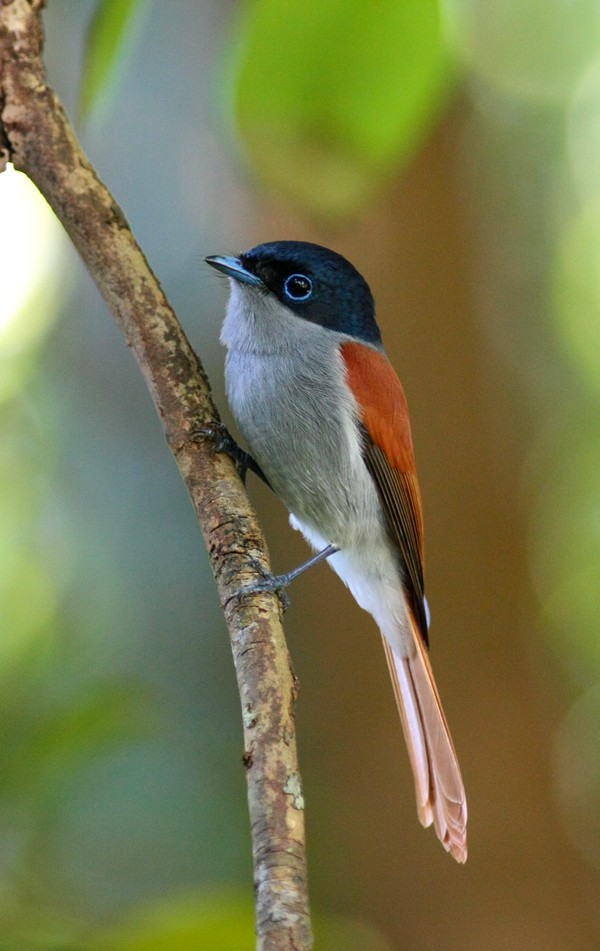
Saint André is not particularly on the birders radar when it comes to Reunion. We however spend our first days on La Reunion here, for we were invited by the Société d´Études Ornithologiques de la Réunion (SEOR) to visit their office and their rescue centre, which is located near Saint André in Cambuston. We stayed just north of Saint André and we saw surprisingly quite a few endemics already: Reunion Grey White-eye (it is noticeably diffirent from its sister species on Mauritius), Reunion Olive White-eye, Mascarene Flycatcher (ssp. borbonnicus which has apparently been split from the subspecies on Mauritius) and most surprising several pairs of Reunion Harrier (a reliable site is the barren field next to the SEOR office).
Male Mascarene Paradise Flycatcher (Terpsiphone (borbonnensis) borbonnensis)
Reunion Olive White-eye (Zosterops olivaceus)
Reunion Grey White-eye (Zosterops borbonicus)
Mascarene Swiftlet (Aerodramus francicus)
Reunion Harrier (Male) (Circus maillairdi)
Reunion Harrier (male) (Circus maillairdi)

The office and the rescue centre are also well worth a visit, for the staff is very helpful, knowledgeable and friendly and were very willing to show us around. We even got to release two Tropical Shearwaters! The rescue centre takes care of up to 2000 birds each year and 80% of them are petrels or shearwaters. Therefore, if visiting Réunion in March or April, when the peak season for the crashed birds is, I highly recommend swinging by in Saint André, for with a bit of luck you might even see a Mascarene Black Petrel up close! (they get one or two crashed juveniles each year. For more information on Mascarene Black Petrel, see this former post) Just make sure you contact the staff in advance. This can be done through their website: http://www.seor.fr/ The office can be reached by the bus from Saint André to Cambuston. 
Crashed Tropical Shearwater (Puffinus bailloni), ready for release

Wednesday, July 3, 2013

Mauritius January – July 2013, Rodrigues, Ile Aux Cocos

The other major place of interest for birders in Rodrigues is Iles aux Cocos, not because it hosts any endemics, but because several thousand terns breed here. The current estimate lies around 45.000. Sooty Terns, Common White Terns, Common Noddies and Lesser Noddies use this island and the neighbouring Iles aux Sables year round to breed and rest. Although they have a peak from September to November. We however visited in June and still saw plenty of individuals of both species with ease. When visiting in the arctic winter however, much more waders will be around than the single Whimbrel we observed.
Sooty Tern (Onychoprion fuscatus)
Adult Lesser Noddy (Anous tenuirostris)

Juvenile Lesser Noddy (Anous tenuirostris)
Adult Brown Noddy (Anous stolidus)

Juvenile Brown Noddy (Anous stolidus)
Lesser Noddies  (Anous tenuirostris) and one Brown Noddy  (Anous stolidus) allowing good comparison
Adult Common White (or Fairy) Tern (Gygis alba)
Juvenile Common White Tern (Gygis alba) (note the dark spot behind the eye)
Video of a inquisitive juvenile Common White Tern (Gygis alba) (made by Anna van der Kaaden)
Iles aux Cocos is open for public and can be reached by a one hour boat ride from Baie du Nord. Be prepared to wade the last few km to the islet, for the waters are very shallow around it. Several boat men and tour packages are available and a list of all boat men can be obtained in the tourist office in Port Mathurin. We used James (002308750557) from Rodrigues Vacances and paid 1.000 MRU including landing fee, lunch, drinks, pick-up and drop-off. We found this to be a fair price and were happy to pay this for the tern spectacle, which I didn´t want to miss. 

Mauritius January – July 2013, Rodrigues, Grande Montagne Nature Reserve

The Island of Rodrigues, roughly 600 km east of Mauritius, once hosted a myriad of endemics. Unfortunately these all suffered the same fate as most birds on Mauritius. There however more birds survived, barely, than in Rodrigues. Currently four native land vertebrates are left: Rodrigues Fruit Bat, Rodrigues Warbler, Rodrigues Fody and Mourning Gecko. The last one is the only species that is not endemic. The three endemic species can be seen in the forested valleys in the centre of the island, although the fruit bat wanders during the night and can also be observed near the coast.

One of those valleys is Grande Montagne Nature Reserve. MWF Rodrigues has done a marvellous job here in replanting rare and endemic plants to recreate the original forests. The forest looks so good that you can imagine Rodrigues Solitaires walking around here in past times. During our two hour visit to this nature reserve we managed to see both endemic bird species with ease. It was a shame though that the male fodies were in the non-breeding plumage and not in the bright yellow breeding plumage (they are in non-breeding plumage from March to August). On the other hand it was a much more interesting identification challenge. The Rodrigues Fodies have a subtle yellowish wash on their throat and breast and their mantle and scapulars have a chestnut tinge. They also have a shorter tail. Off course their behaviour is very different from the Madagascar Fodies, but I found that the non-breeding Rodrigues Fodies are definitely identifiable on plumage as well. Next to the birds, we saw several Rodrigues Fruit Bats flapping over near Solitude at the MWF Office.
Juvenile Rodrigues Fody (Foudia flavicans)

Rodrigues Warbler (Acrocephalus rodericanus)
Rodrigues Fruit Bat (Pteropus rodricensis)

The Grande Montagne Nature Reserve is open and free for public and all trails start at the Louis Dominique Farla Information Centre. Here you can also have a look at the bones of the extinct Rodrigues Solitaire and Doomed Tortoise. The information centre can be reached by the Port Mathurin – Point Coton or the Port Mathurin – Grande Montagne bus. Just ask the drivers to drop you there, it is just next to the road. Guides are not necessary, but it might be interesting to phone the MWF Rodrigues (002308314558) in advance, for they are happy to show you around and they have vast knowledge about the local fauna and flora. They might also show you their plant nursery in Solitude where they propagate rare and endemic plants. We enjoyed their company and their knowledge a lot and highly recommend them. 

Friday, June 21, 2013

Mauritius January - July 2013, Round Island

Round Island, 25 km North of Mauritius functions as a refugium for critically endangered species, mostly reptiles and plants. Many plants that can be found here have vanished from other places, like the Hurricane Palm, a species which was down to just one last individual, but is now on the return thanks to MWF (individuals can be seen on Iles aux Aigrettes). The reptile community is just as unique for the Keel-scaled Boa, Durrel´s Night Gecko, Guenther´s Day Gecko, Ornate Day Gecko and Telfair´s Skink were restricted to this small island (recent translocations have enlarged their distribution). MWF is still working hard on the restauration of the island and the protection of its inhabitants.
Guenther´s Day Gecko (Phelsuma guentheri)
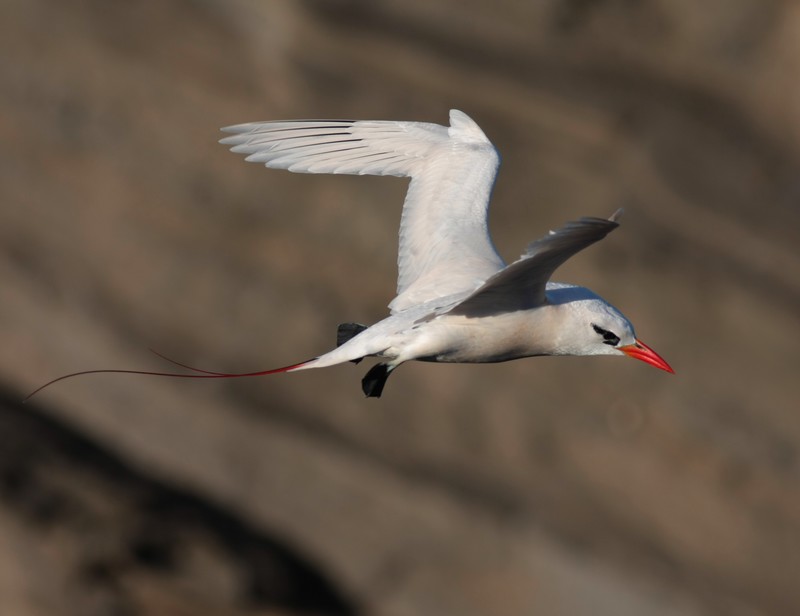
We were allowed to help with the restauration for 10 days, which was for us a highlight of our stay in Mauritius. This work enabled us to get up close with the breeding seabirds on this island. Round Island for instance hosts the largest colony in the Indian Ocean of Red-tailed Tropicbirds (2.000 - 2.500 pairs) and Wedge-tailed Shearwaters (40.000 - 80.000 pairs). An estimated 750 to 1.500 pairs of White-tailed Tropicbirds also breed on the island. Since 40ties breeding petrels have been sighted. These have always been identified as Trindade Petrels (Pterodroma arminjoniana), but today it is a bit more complicated than that. In in 1987 the first Bulwer´s Petrel was found, in 1994 the first Kermadec Petrel (P. neglecta) and in 1995 the first Herald Petrel (P. heraldica). Currently seven Pterodroma species have been sighted on the island and three of those breed (Black-winged Petrel (P. nigripennis) made several attempts but all of them failed). The three species that breed on Round Island are Trindade, Kermadec and Herald Petrel. These three species are possibly hybridising, which makes the identification of individual birds on Round Island difficult to say the least. In the next paragraphs I will try to give some clues to the identification so that it might increase the insight of this difficult species complex.
Red-tailed Tropicbird (Pheaton rubricauda)

White-tailed Tropicbird (Phaeton lepturus)
Trindade Petrels
The vast majority of the Pterodromas on Round Island are Trindade Petrels (120 to 170 breeding pair). The majority of these birds belong the dark morph. The dark morph on Round Island differs a bit from 
the dark morph on Trindade Island, for the birds in the Indian Ocean almost never show a pale throat. The intermediate and light morph are much less numerous. I even did not see any light morphs at all. The genetics of the Round Island form of Trindade Petrel also differs a bit from the other population in the genetics, but it is hard to give them a (sub)specific status due to the hybridisation that causes the species boundaries to fade...
Intermediate morph Trindade Petrel (Pterodroma arminjoniana)
Dark morph Trindade Petrel (Pterodroma arminjoniana)
Kermadec Petrels
An estimated 10 to 15 pairs of Kermadec Petrel breed on Round Island, but the total number of birds varies from month to month. Also this species is mostly represented here by dark en intermediate morphs. The white-headed morp of this species has even only been seen twice with certainty. Hybridisation with this species and Trindade has been proven. Because of high variety within the species and hybridisation it is hard to identify species just by plumage: head, upperwing and underwing patterns and colouration (although I got the feeling that Kermadec Petrels have a warmer colouration in general). It is therefore, in my opinion, only possible to indentify extreme plumages with certainty, unless the colouration of the primairy shafts can be observed. Kermadec Petrels have white primairy shafts and Herald and Trindade Petrels have dark primairy shafts. The primairy shafts of hybrids are apparently half dark half light. Besides the plumage charactaristics, sound is a very usefull way to identify Kermadec Petrel.
Dark morph Kermadec Petrel (Pterodroma neglecta)
Intermediate morph Kermadec Petrel (Pterodroma neglecta)

Herald Petrels
About the same amount of individual live on Round Island for the Herald Petrel as for the Kermadec Petrel (10 to 15 breeding pairs), in my opinion however, this species is overlooked even more often. The most obvious variant (and according to Carl Jones the only variant occuring here) is the lightest variant. Most of individuals are smaller with a shorter bill (but the there is quite a lot of overlap in the morphologic characteristics of all the three species). Herald petrels also have subtile vermiculations on the chest and light lores. I have also seen birds that have half of the characteristics of a Herald Petrel and half those of a Trindade petrel. Are these individuals hybrids or just deviation within the species?
Light morph Herald Petrel (Pterodroma heraldica)
Intermediate Morph Herald Petrel (Pterodroma heraldica) (picture taken by Anna van der Kaaden)
Phoenix Petrels
Besides these three breeding species and their hybrides there are some rumors about a fourth species that might be breeding here: the Phoenix Petrel. I think the description of this species sounds a lot like an intermediate variant of Trindade Petrel. According to Only and Scofield (Albatrosses, Petrels and Shearwaters of the World) are white undertail coverts and dark underwings good features for a Phoenix Petrel. However, I have seen quite a lot of Trindade Petrels (light underwings) with white undertail coverts. Are these deviating Trindade Petrels? Besides that I have seen a small number of birds that meet the criteria for a Phoenix Petrel, but with a silver haze on the underwings. The photos below show the best candidates for Phoenix Petrel and in Carl Jones´s opinion they actually are.
Update: I´ve send the pictures below to several experts like Paul Scofield, Robert Flood and Daniel Dankwerts. The bird on the upper picture is most likely a Herald Petrel. It shows the pale undertail coverts, bicoloured feet and a pale leading edge, that are good fore Phoenix Petrel, but the pale crescent formed by the pale bases of the primaries does not fit and the dark breast appears to messy and ragged. Trindade Petrel can be excluded by wing shape, for this bird has rather slender wings and does not fit the broad-winged jizz of Trindade Petrel. The bird on the lower picture is most likely a dark or intermediate morph Trindade Petrel, for even though it had white undertail coverts, the white on the underwings is way to extensive for a Phoenix Petrel
Possible Phoenix Petrel that turned out to be most likely a dark morph Herald Petrel (Pterodroma heraldica)
Possible Phoenix Petrel that turned out to be a dark morph Trindade Petrel (Pterodroma arminjoniana)
Luckily birds can also be identified by sound and at least Kermadec Petrel is an easy one to pick out,  because it produces a donky like call. Vocalisations of Trindade and Herals Petrel sound a lot alike. Both produce a chittering noise, but Trindade Petrel ends with a series of low gutteral sounds. Herald Petrel does not produce these low noises. It´s chittering call fades against the end. Sonograms can show this difference really well. Unfortunately I have the feeling that Trindade Petrels tend to leave the low noises out of their call and to stop abruptly after chittering. I think that Phoenix Petrels sounds a lot like a Herald Petrel of a prematurely stoping Trindade Petrel. This all does not make identification much easier. 

The three species (excluding Phoenix Petrel) are closely related and speciation most likely occured not so long ago as the consequence of them breeding in different colonies. This not only makes hybridisation possible but also causes the progeny to be fertile. This causes introgression of at least Kermadec Petrel genes in the Trindade Petrel population on Round Island. (Hybridisation with Herald Petrel has not yet been shown, but it is very plausible. I also am not aware of any interbreeding between Herald and Kermadec Petrels, but this seems less plausible due to the low numbers of breeding birds in both species.) The introgression of genes causes the species boundary to fade more and more with in the end a big hybrid swarm with barely identifiable individual birds. While I was on Round Island, I could see the interspecies interaction myself, for I observed display flights between Trindade Petrels and Herald Petrels and Trindade Petrels and Kermadec Petrels. However I did not see any  Kermadec x Kermadec or Herald x Herald display flights. Currently a lot of DNA research is being conducted on these petrels, but the DNA is not being linked to plumage charactaristics, which makes the research fairly useless for identification issues. So there is still a long way to go...
Kermadec Petrel (Pterodroma neglecta) intermediate morph in display flight with Trindade Petrel (Pterodroma arminjoniana) intermediate morph
Possible Kermadec X Trindade Petrel Hybrid (Pterodroma neglecta X Pterodroma arminjoniana) (picture taken by Anna van der Kaaden)
Access to Round Island itself is not permetted for the "normal birder", but boat trips around the island can be organised and this gives birders a reasonable chance to see Trindade Petrels. Seeing the other species will be a bit more difficult and probably mostly depend on luck. I saw several Trindade Petrels flying between Flat Island and Guenners Coin. Other birds of interest were Brown and Lesser Noddies, Sooty Tern and Subantartic Skua (a vagrant to Mauritius)

For more information about this matter read “Lost Land of the Dodo” by A. Cheke and P.J. Hume, “The breeding biology of the Round Island Petrel and factors determining breeding succes” by R.V. Tatayah, “Occurence of two surface breeding species of Pterodroma on Round Island, Indian Ocean” by M. Brook, M.J. Imber and G. Rowe and “Range expansion and hybridization in Round Island Petrels (Pterodroma ssp.): evidence from microsatellite genotypes” by R.M. Brown, R.A. Nichols, C.G. Faulkes et al.
Round Island (picture taken by Anna van der Kaaden)

Wednesday, June 19, 2013

Mauritius January - July 2013, Petrin, Camp Field Station and Brise Fer

These three sites are all quite close to each other and this part of the national park probably holds the best upland forest of the entire country, for much weed control is taking place. The forest holds a high density of native trees like Black Ebony or Screw Pine (Vacoas), however the understory in the places that have not been weeded is still covered in several dozens of Chinese Guavas, forming an impenetrable wall... Camp Field Station and Brise Fer are both more or less of Limits to the public, but the forest around them is reasonably good and well worth a visit, for it holds the same species, just not as close up. They can be reached by hiking from the Petrin Field Station. A guide is not mandatory. This hike also offers a scenic view over the gorges. Visits to Camp field station itself might be organised through MWF but I´m not sure if they still do this...

This area holds the biggest sub-population of Echo Parakeets (several 100), but most descent from hand reared birds and almost all birds depend on supplementary feeding. The same goes for the 90 Pink Pigeons around Brise Fer and the 15 around the Petrin visitors center. On the other hand, Brise Fer, Camp field station and the Parakeet Trail are probably the best places in the world to see Mauritius Cuckooshrikes and there is no project assigned to this species, so it is completely tickeable. Maurtius Bulbul also roams these forests. The Brise Fer area is also very interesting for reptile enthusiasts, for it is one of the few places on earth where Upland Day Geckos and Macchabee Skink can be seen, though they are very hard to find.
Female Echo Parakeet (Psittacula eques)

This part of the national park should not be missed, for it offers great views, Mauritius Cuckooshrikes and above all more or less healthy native forests. It might be interesting for photographers to arrange a visit to the field station, for close up views of Echo Parakeet and Pink Pigeon are guaranteed.

Tuesday, March 19, 2013

Mauritius January - July 2013, Bel Ombre Field Station

Bel Ombre MWF field station is located in the south of the national park near the village Bel Ombre. Although trucks regularly pass the field station, is the access to the public rather limited and therefore I will keep this post rather short.

Endemics that can be seen around the field station are Pink Pigeons (40 individuals that depend on supplementary feeding), Echo Parakeets (a small translocated population that depends on supplementary feeding), Mauritius Kestrel (a genuine wild pair, that only depends on a nest box) and Mauritius Bulbul. The Bel Ombre Uppers, a patch of forest a couple of km from the field station, also holds very small numbers of Mauritius Olive White-eyes, Mauritius Fodies and Mauritius Cuckooshrikes, but I have no idea how the public can access this site. I would recommend visiting another site than put energy in trying to see this off limits site...
  Male Mauritius Kestrel (Falco punctatus)

Monday, February 25, 2013

Mauritius January - July 2013, Ile Aux Aigrettes

Iles Aux Aigrettes is The place where most birders tick off Mauritius Olive White-eye and Maurtius Fody. Both of these critically endangered species have been introduced to the island and depend heavily on supplementary feeding, so the purist birders should not visit this island. The same goes for the small population of Pink Pigeons of this island. Besides the endemic birds, MWF has also started translocating White-tailed and Red-tailed Tropicbirds, Wedge-tailed Shearwaters, Sooty Terns and Common Noddies. Of these species, White-tailed Tropicbird are probably the only ones you might see, for wild (or former translocated) individuals regularly fly over the island.
Male Mauritius Fody (Foudia rubra)

Mauritius Olive White-eye (Zosterops chloronotus)

Juvenile Sooty Tern (Onychoprion fuscatus) 
Common Noddy (juvenile) (Anous stolidus)
The island also holds a substantial (introduced) population of Telfair´s Skink and Ornate Day Gecko and now also Guenther´s Day Gecko. Both species are now limited more or less to Round Island and Iles aux Aigrettes is now holding a back-up population which is also used for research. The reptile community on the island also hosts the introduced Aldabra Giant Tortoises, who are being used as analog species for the extinct native Giant Tortoises. Some truly massive individuals can be found here (more than 90 years old)
Ornate Day Gecko (Phelsuma ornata)
Aldabra Giant Tortoise (Aldabrachelys gigantea)
Most birders visit the island because it is easily accissible and the sites where wild Fodies and Olive White-eyes occur are not or barely known.  The island can be reached only by an organised tour. Such a tour can be arranged at the Ecotours office opposite of Pointe Jerome, between Mahebourg and Blue Bay. Special tours can be organised for birders on request, but keep in mind that for the MWF staff it is much more convenient if these are requested in the weekends, for then they will have time to assist you. Anyways, the island is defenitely worth a visit, for it holds the last patch of (restored) coastal forest with loads of critically endangered plant species and walking through this is a nice experience.
Feeding time for the Mauritius Fodies on Ile aux Aigrettes (clip made by Johannes Chambon) 

Tuesday, February 19, 2013

Mauritius January - July 2013, Combo Fieldstation

For four months I have been based at Combo field station, which is situated in the far East of the national park. The forest here is rather lousy and 80% of the trees here are the introduced Syzigium jambos. Although some Black Ebony trees can still be found and one tree species is actually endemic to this shitty forest and all 10 individuals of this species are found here!

For birders this site has special interest for it holds the biggest wild population of Mauritius Olive White-eyes. The population here gets no support apart from predator control and are therefore tickeable, even by the purist. This site also holds amongst others a subpopulation of Pink Pigeons (70 individuals, who receive supplementary feeding), Mauritius Bulbuls and Mauritius Paradise Flycatchers. We even found an abarrent individual that was most likely suffering from an allosome linked pigment deficiency called "Brown", which causes a qualitative reduction in eumelanine, but leaves phaeomelanine untouched. This results in a bleached plumage that turns paler over time as the effected eumelanine degrades in UV light. Signs that distinguish Brown from Leucism or Albinism include normal iris colour, parts that retain a certain amount of colour (caused by phaeomelanine) and most importantly parts of the plumage that are less exposed to sunlight are clearly less bleached. Apart from the avian attractions the forests here hold big roosts of the Mascarene Fruit Bat and they flap over regularly during the day.
7-8 weeks old Juvenile Pink Pigeon (Nesoenas mayeri)
Male Mauritius Paradise Flycatcher (Terpsiphone (bourbonnensis) desolata)
Female Mauritius Paradise Flycatcher (Terpsiphone (bourbonnensis) desolata) with a pigment deficiency called "Brown", which causes a qualitative reduction of eumelanine. Note the less bleached inner primairies and outer secondairies!
Access to this site is rather difficult, but not impossible. Hikes can be arranged through Exsul Lodges and these pass through the field station clearing. I have no idea what hike passes Combo field station (it might be the hike to Piton Savanne), so to be sure to ask Exsul Lodges. If you are not a purist I would not recommend going through all this hassle and just twitch the Olive White-eyes on Iles aux Aigrettes, where sightings are much more common than here.
Female Blue-tailed Day Gecko (Phelsuma cepediana)