Showing posts with label Mauritian Mainland. Show all posts

Wednesday, June 19, 2013

Mauritius January - July 2013, Petrin, Camp Field Station and Brise Fer

These three sites are all quite close to each other and this part of the national park probably holds the best upland forest of the entire country, for much weed control is taking place. The forest holds a high density of native trees like Black Ebony or Screw Pine (Vacoas), however the understory in the places that have not been weeded is still covered in several dozens of Chinese Guavas, forming an impenetrable wall... Camp Field Station and Brise Fer are both more or less of Limits to the public, but the forest around them is reasonably good and well worth a visit, for it holds the same species, just not as close up. They can be reached by hiking from the Petrin Field Station. A guide is not mandatory. This hike also offers a scenic view over the gorges. Visits to Camp field station itself might be organised through MWF but I´m not sure if they still do this...

This area holds the biggest sub-population of Echo Parakeets (several 100), but most descent from hand reared birds and almost all birds depend on supplementary feeding. The same goes for the 90 Pink Pigeons around Brise Fer and the 15 around the Petrin visitors center. On the other hand, Brise Fer, Camp field station and the Parakeet Trail are probably the best places in the world to see Mauritius Cuckooshrikes and there is no project assigned to this species, so it is completely tickeable. Maurtius Bulbul also roams these forests. The Brise Fer area is also very interesting for reptile enthusiasts, for it is one of the few places on earth where Upland Day Geckos and Macchabee Skink can be seen, though they are very hard to find.
Female Echo Parakeet (Psittacula eques)

This part of the national park should not be missed, for it offers great views, Mauritius Cuckooshrikes and above all more or less healthy native forests. It might be interesting for photographers to arrange a visit to the field station, for close up views of Echo Parakeet and Pink Pigeon are guaranteed.

Tuesday, March 19, 2013

Mauritius January - July 2013, Bel Ombre Field Station

Bel Ombre MWF field station is located in the south of the national park near the village Bel Ombre. Although trucks regularly pass the field station, is the access to the public rather limited and therefore I will keep this post rather short.

Endemics that can be seen around the field station are Pink Pigeons (40 individuals that depend on supplementary feeding), Echo Parakeets (a small translocated population that depends on supplementary feeding), Mauritius Kestrel (a genuine wild pair, that only depends on a nest box) and Mauritius Bulbul. The Bel Ombre Uppers, a patch of forest a couple of km from the field station, also holds very small numbers of Mauritius Olive White-eyes, Mauritius Fodies and Mauritius Cuckooshrikes, but I have no idea how the public can access this site. I would recommend visiting another site than put energy in trying to see this off limits site...
  Male Mauritius Kestrel (Falco punctatus)

Monday, February 25, 2013

Mauritius January - July 2013, Ile Aux Aigrettes

Iles Aux Aigrettes is The place where most birders tick off Mauritius Olive White-eye and Maurtius Fody. Both of these critically endangered species have been introduced to the island and depend heavily on supplementary feeding, so the purist birders should not visit this island. The same goes for the small population of Pink Pigeons of this island. Besides the endemic birds, MWF has also started translocating White-tailed and Red-tailed Tropicbirds, Wedge-tailed Shearwaters, Sooty Terns and Common Noddies. Of these species, White-tailed Tropicbird are probably the only ones you might see, for wild (or former translocated) individuals regularly fly over the island.
Male Mauritius Fody (Foudia rubra)

Mauritius Olive White-eye (Zosterops chloronotus)

Juvenile Sooty Tern (Onychoprion fuscatus) 
Common Noddy (juvenile) (Anous stolidus)
The island also holds a substantial (introduced) population of Telfair´s Skink and Ornate Day Gecko and now also Guenther´s Day Gecko. Both species are now limited more or less to Round Island and Iles aux Aigrettes is now holding a back-up population which is also used for research. The reptile community on the island also hosts the introduced Aldabra Giant Tortoises, who are being used as analog species for the extinct native Giant Tortoises. Some truly massive individuals can be found here (more than 90 years old)
Ornate Day Gecko (Phelsuma ornata)
Aldabra Giant Tortoise (Aldabrachelys gigantea)
Most birders visit the island because it is easily accissible and the sites where wild Fodies and Olive White-eyes occur are not or barely known.  The island can be reached only by an organised tour. Such a tour can be arranged at the Ecotours office opposite of Pointe Jerome, between Mahebourg and Blue Bay. Special tours can be organised for birders on request, but keep in mind that for the MWF staff it is much more convenient if these are requested in the weekends, for then they will have time to assist you. Anyways, the island is defenitely worth a visit, for it holds the last patch of (restored) coastal forest with loads of critically endangered plant species and walking through this is a nice experience.
Feeding time for the Mauritius Fodies on Ile aux Aigrettes (clip made by Johannes Chambon) 

Tuesday, February 19, 2013

Mauritius January - July 2013, Combo Fieldstation

For four months I have been based at Combo field station, which is situated in the far East of the national park. The forest here is rather lousy and 80% of the trees here are the introduced Syzigium jambos. Although some Black Ebony trees can still be found and one tree species is actually endemic to this shitty forest and all 10 individuals of this species are found here!

For birders this site has special interest for it holds the biggest wild population of Mauritius Olive White-eyes. The population here gets no support apart from predator control and are therefore tickeable, even by the purist. This site also holds amongst others a subpopulation of Pink Pigeons (70 individuals, who receive supplementary feeding), Mauritius Bulbuls and Mauritius Paradise Flycatchers. We even found an abarrent individual that was most likely suffering from an allosome linked pigment deficiency called "Brown", which causes a qualitative reduction in eumelanine, but leaves phaeomelanine untouched. This results in a bleached plumage that turns paler over time as the effected eumelanine degrades in UV light. Signs that distinguish Brown from Leucism or Albinism include normal iris colour, parts that retain a certain amount of colour (caused by phaeomelanine) and most importantly parts of the plumage that are less exposed to sunlight are clearly less bleached. Apart from the avian attractions the forests here hold big roosts of the Mascarene Fruit Bat and they flap over regularly during the day.
7-8 weeks old Juvenile Pink Pigeon (Nesoenas mayeri)
Male Mauritius Paradise Flycatcher (Terpsiphone (bourbonnensis) desolata)
Female Mauritius Paradise Flycatcher (Terpsiphone (bourbonnensis) desolata) with a pigment deficiency called "Brown", which causes a qualitative reduction of eumelanine. Note the less bleached inner primairies and outer secondairies!
Access to this site is rather difficult, but not impossible. Hikes can be arranged through Exsul Lodges and these pass through the field station clearing. I have no idea what hike passes Combo field station (it might be the hike to Piton Savanne), so to be sure to ask Exsul Lodges. If you are not a purist I would not recommend going through all this hassle and just twitch the Olive White-eyes on Iles aux Aigrettes, where sightings are much more common than here.
Female Blue-tailed Day Gecko (Phelsuma cepediana)

Friday, January 25, 2013

Mauritius January - July 2013, Pigeon Wood Field Station

The following posts will be a bit different from the usual site reviews, for most sites were visited while working for the Mauritian Wildlife Foundation as a volunteer on the Pink Pigeon Program. Therefore I spent several months at some sites, who are not or barely open for the "normal" birder. I will try to make the reviews considering these sites as useful as possible.

The first site in the field was the field station called Pigeon Wood. Here I got my training as a Pink Pigeon volunteer. The site is located in the east of the Black River Gorges National Park and holds the second largest Pink Pigeon population (90 birds). For birders, especially the purists among them,  this site should hold special interest, for non of the Pink Pigeons here are translocated and all originate from the last 12 individuals that were found here in the 90ties. However the pigeons of this subpopulation still get supplementary feeding. This area also holds the biggest wild population of Mauritian Fodies. These Fodies are tickeable, even by purists, for here they are not beeing fed or translocated. Other birds of interest in the forests around Pigeon Wood include Mauritius Bulbul, Mascarene Paradise Flycatcher (ssp. desolata, apparently recently split from the nominate subspecies on Reunion) and the ever-present Mauritius Grey White-eye. Other animals of interest are the endemic Blue-tailed Day Gecko and the only native mammal of Mauritius: the Mascarene (or Black-spined) Fruit Bat.
Mauritius Bulbul (Hypsipetes olivaceus)

Female Mauritius Fody (Foudia rubra) carrying nest material (check out those wingbars!)
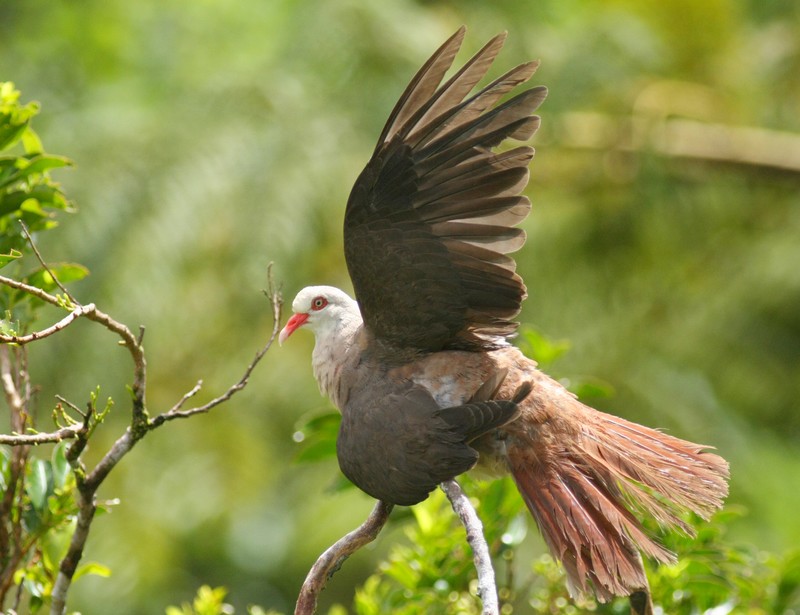
Adult male Pink Pigeon (Nesoenas mayeri) sunbathing

Mauritius Grey White-eye (Zosterops mauritianus)
Access to this site is a bit difficult, for the track that leads to Pigeon Wood Field Station can only be accessed with a guide. (Contact MWF for more information) This might be annoying, but (very) close up views of Pink Pigeons around the field station are almost guaranteed.
Male Blue-tailed Day Gecko (Phelsuma cepediana)