Showing posts with label Réunion. Show all posts

Sunday, July 14, 2013

Réunion July 2013, La Roche Ecrite

This is The site in Réunion for birders, for it is the only place in the world, where all land endemics of Réunion can be seen. Most of these can be seen throughout the entire island, but Reunion Cuckooshrike is confined to this single mountain and therefore the site is a must for birders. Most birders state that it is necessary to start the trail in the first light, because otherwise it will be rainy or misty or busy with hikers or all three of them. We however visited the island in July, so in winter, which turned out to be perfect. We started at 8:00 leisurely with researcher from SEOR, the weather was perfect all day, there were a few hikers, but not much and best of all: the cuckooshrike is not breeding. This means that tape can be used (in decent quantities) without disturbing this critically endangered species too much. Around 11:00 we found a responsive male near the first area that has been completely cleared of Cryptomeria japonica, an invasive tree species. There is a small sign next to the area stating that rats are the biggest threat to the cuckooshrike. We stood next to the sign and after a while a male Reunion Cuckooshrike preformed marvelously around us. We also saw all other land endemics at this site with ease, including a displaying male Reunion Harrier.
Male Reunion Cuckooshrike (Coracina newtoni)

Even though I used tape to see the main attraction here, I would definitely refrain from using it in the breeding season, for there are only 33 pairs in the world and there are already enough factors interfering with their breeding success. With the last land endemic seen we finished our birding on this special island resulting in list of a staggering 13 species. When visiting Mauritius, which seems to be more well-known with birders, I highly recommend including Réunion into your itinerary. To be honest, I like Réunion more than Mauritius.

Réunion July 2013, Dimitile

This is another site off the birder radar, but also well worth a visit. We were invited by the SEOR staff to stay a night here and help them with their predator control on this site to protect tubenose colonies. Unfortunately all tubenoses were gone when we were here (from May to August almost all tubenoses that breed at Réunion are at sea). However it might be interesting to listen during a night in this area in the right time of the year. We stayed at Gite Emile, which is a very nice place, with an amazing view, if it is not cloudy. Actually, the entire Dimitile area is very photogenic and most views are simply breath-taking, especially the one into Cirque de Cilaos. Off course there are birds here as well. We observed all land endemics here except the cuckooshrike, which is confined to La Roche Ecrite (see next post). Surprisingly encountered several Reunion Harriers again, some of them in the spectacular display flight and calling out loud! I expected them to be much harder to find and much less common. The dimitile area can be reached only by foot. The tracks start around Entre Deux. We especially enjoyed the track that starts at Zebre. Entre Deux can be reached by bus from Saint Pierre. 
 Male Reunion Stonechat (Saxicola tectes)
Female Reunion Stonechat (Saxicola tectes)
Reunion Bulbul (Hypsipetes borbonicus)

Réunion July 2013, Saint André

Saint André is not particularly on the birders radar when it comes to Reunion. We however spend our first days on La Reunion here, for we were invited by the Société d´Études Ornithologiques de la Réunion (SEOR) to visit their office and their rescue centre, which is located near Saint André in Cambuston. We stayed just north of Saint André and we saw surprisingly quite a few endemics already: Reunion Grey White-eye (it is noticeably diffirent from its sister species on Mauritius), Reunion Olive White-eye, Mascarene Flycatcher (ssp. borbonnicus which has apparently been split from the subspecies on Mauritius) and most surprising several pairs of Reunion Harrier (a reliable site is the barren field next to the SEOR office).
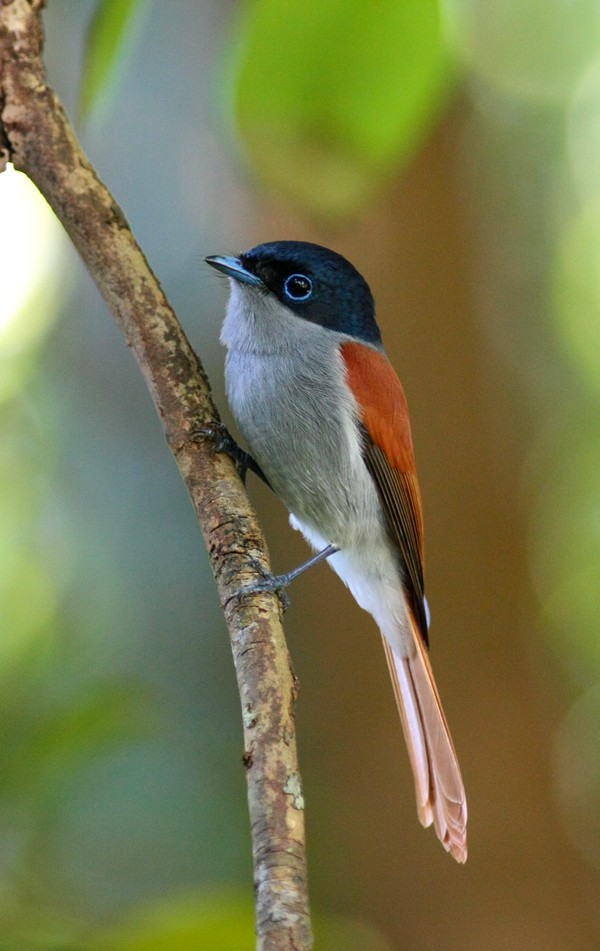
Male Mascarene Paradise Flycatcher (Terpsiphone (borbonnensis) borbonnensis)
Reunion Olive White-eye (Zosterops olivaceus)
Reunion Grey White-eye (Zosterops borbonicus)
Mascarene Swiftlet (Aerodramus francicus)
Reunion Harrier (Male) (Circus maillairdi)
Reunion Harrier (male) (Circus maillairdi)

The office and the rescue centre are also well worth a visit, for the staff is very helpful, knowledgeable and friendly and were very willing to show us around. We even got to release two Tropical Shearwaters! The rescue centre takes care of up to 2000 birds each year and 80% of them are petrels or shearwaters. Therefore, if visiting Réunion in March or April, when the peak season for the crashed birds is, I highly recommend swinging by in Saint André, for with a bit of luck you might even see a Mascarene Black Petrel up close! (they get one or two crashed juveniles each year. For more information on Mascarene Black Petrel, see this former post) Just make sure you contact the staff in advance. This can be done through their website: http://www.seor.fr/ The office can be reached by the bus from Saint André to Cambuston. 
Crashed Tropical Shearwater (Puffinus bailloni), ready for release

Saturday, January 19, 2013

Indian Ocean January 2013, Tamatave – Port Louis

The last days before our volunteering on Mauritius began were spent on the Indian Ocean. Instead of flying the Mauritius Shipping Corporation (http://www.mauritiusshipping.intnet.mu/) offers the possibility to go by boat. The crossing takes three days and is cheaper than a one-way ticket, however the Corporation offers only one crossing per month. We paid 250 euro for a one-way ticket in second class and I think it is absolutely worth it. The fare includes all meals (very decent meals) and it gives you the opportunity to see some seabirds. However make sure you don´t get sea sick, for the Indian Ocean is a rough sea. We tried Sea Bands (http://www.sea-band.com/), but we still felt dizzy and nauseous, especially when the ship encountered a tropical storm on the open sea.

We found the open sea between Madagascar and Reunion very, very empty and did not see much, just a single tubenose and some flying fish. This tubenose however deserves special attention. This species is one of the rarest sea birds in the world and breeds on La Réunion. Seeing the species at La Réunion is close to impossible, even though many people claim to have seen one. I´ve spoken a lot with the researchers who work on this species on La Reunion. One of them has worked on them for 11 years and has seen one at sea and had around 10 crashed individuals in his hand. The colony of this petrel is still unknown, but is most likely located in the south of the island. The only realistic, but slim chance of seeing a Mascarene Black Petrel is taking a boat to the sea, preferably between St. Pierre and St. Louis. The best time of the year to do this is between February and April. The researcher who saw a Mascarene Black Petrel here however needed 10 to 15 attempts to succeed. There are even sightings of Mauritius, but these are probably all misidentified dark morph Trindade Petrels (see Round Island). So it is obvious that this species is extremely rare. The only reason that people know that it still exists are the one or two juveniles that are rescued on la Réunion each year. The pictures below show a good candidate Mascarene Black Petrel, according to the scientists, but I´m defenitely not sure and will look into it further. The bird was flying very close to the water with slow, but three to four strong wing beats interspaced by gliding pauses. The bird was rather small and completely dark without any obvious plumage features. Unfortunately it stayed far from the boat and therefore the pictures are rather crappy.
After looking into it further and asking several tubenose specialists for help, it turns out that this bird is most likely a Jouanin´s Petrel. 
Jouanin´s Petrel (Bulweria fallax)
In the right time of the year encounters with whales in this stretch of the ocean are apparently not uncommon and the captain is even willing to stop the boat so the passengers can enjoy these giants for a while. The waters directly around Reunion proved to be more productive with 50 Barau´s Petrels, several hundreds of Tropical Shearwaters and 50 Wedge-tailed Shearwaters. A long stop in the port of Reunion produced also some Mascarene Swiftlets.  Most tubenoses were observed at dusk around Reunion when the birds come back from the sea to the land.
Barau´s Petrel (Pterodroma baraui)
Tropical Shearwater (Puffinus bailloni)
Tropical Shearwaters (Puffinus bailloni)
Wedge-tailed Shearwater (Puffinus pacificus) (pink-billed variant)
I can highly recommend doing this boat trip instead of flying, for it crosses an area rarely covered by birders and who knows what hangs around there. Indian Yellow-nosed and Salvin´s Albatross are definitely among the possibilities. Apart from that, we found our boat, the MS Trochetia, a very comfortable boat, especially compared to Malagasy taxi-brousses.
Open Ocean (picture made by Anna van der Kaaden)