Friday, June 21, 2013

Mauritius January - July 2013, Round Island

Round Island, 25 km North of Mauritius functions as a refugium for critically endangered species, mostly reptiles and plants. Many plants that can be found here have vanished from other places, like the Hurricane Palm, a species which was down to just one last individual, but is now on the return thanks to MWF (individuals can be seen on Iles aux Aigrettes). The reptile community is just as unique for the Keel-scaled Boa, Durrel´s Night Gecko, Guenther´s Day Gecko, Ornate Day Gecko and Telfair´s Skink were restricted to this small island (recent translocations have enlarged their distribution). MWF is still working hard on the restauration of the island and the protection of its inhabitants.
Guenther´s Day Gecko (Phelsuma guentheri)
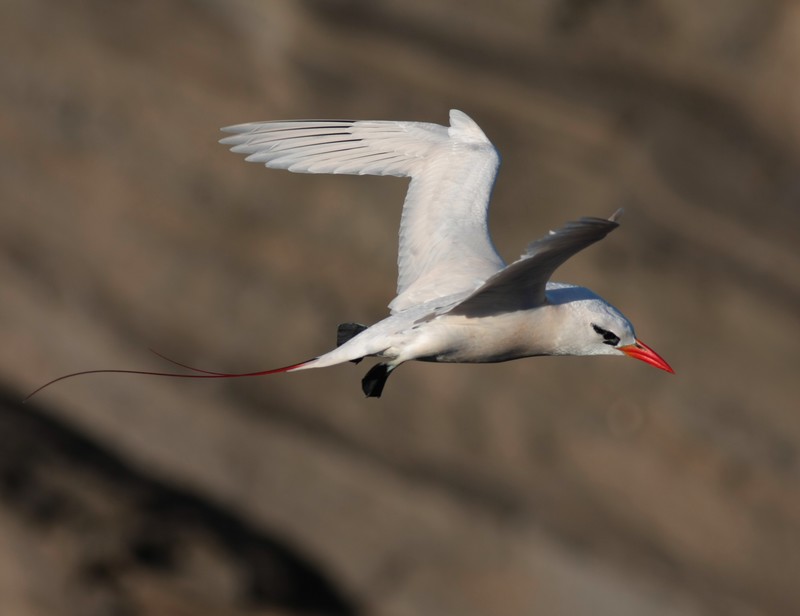
We were allowed to help with the restauration for 10 days, which was for us a highlight of our stay in Mauritius. This work enabled us to get up close with the breeding seabirds on this island. Round Island for instance hosts the largest colony in the Indian Ocean of Red-tailed Tropicbirds (2.000 - 2.500 pairs) and Wedge-tailed Shearwaters (40.000 - 80.000 pairs). An estimated 750 to 1.500 pairs of White-tailed Tropicbirds also breed on the island. Since 40ties breeding petrels have been sighted. These have always been identified as Trindade Petrels (Pterodroma arminjoniana), but today it is a bit more complicated than that. In in 1987 the first Bulwer´s Petrel was found, in 1994 the first Kermadec Petrel (P. neglecta) and in 1995 the first Herald Petrel (P. heraldica). Currently seven Pterodroma species have been sighted on the island and three of those breed (Black-winged Petrel (P. nigripennis) made several attempts but all of them failed). The three species that breed on Round Island are Trindade, Kermadec and Herald Petrel. These three species are possibly hybridising, which makes the identification of individual birds on Round Island difficult to say the least. In the next paragraphs I will try to give some clues to the identification so that it might increase the insight of this difficult species complex.
Red-tailed Tropicbird (Pheaton rubricauda)

White-tailed Tropicbird (Phaeton lepturus)
Trindade Petrels
The vast majority of the Pterodromas on Round Island are Trindade Petrels (120 to 170 breeding pair). The majority of these birds belong the dark morph. The dark morph on Round Island differs a bit from 
the dark morph on Trindade Island, for the birds in the Indian Ocean almost never show a pale throat. The intermediate and light morph are much less numerous. I even did not see any light morphs at all. The genetics of the Round Island form of Trindade Petrel also differs a bit from the other population in the genetics, but it is hard to give them a (sub)specific status due to the hybridisation that causes the species boundaries to fade...
Intermediate morph Trindade Petrel (Pterodroma arminjoniana)
Dark morph Trindade Petrel (Pterodroma arminjoniana)
Kermadec Petrels
An estimated 10 to 15 pairs of Kermadec Petrel breed on Round Island, but the total number of birds varies from month to month. Also this species is mostly represented here by dark en intermediate morphs. The white-headed morp of this species has even only been seen twice with certainty. Hybridisation with this species and Trindade has been proven. Because of high variety within the species and hybridisation it is hard to identify species just by plumage: head, upperwing and underwing patterns and colouration (although I got the feeling that Kermadec Petrels have a warmer colouration in general). It is therefore, in my opinion, only possible to indentify extreme plumages with certainty, unless the colouration of the primairy shafts can be observed. Kermadec Petrels have white primairy shafts and Herald and Trindade Petrels have dark primairy shafts. The primairy shafts of hybrids are apparently half dark half light. Besides the plumage charactaristics, sound is a very usefull way to identify Kermadec Petrel.
Dark morph Kermadec Petrel (Pterodroma neglecta)
Intermediate morph Kermadec Petrel (Pterodroma neglecta)

Herald Petrels
About the same amount of individual live on Round Island for the Herald Petrel as for the Kermadec Petrel (10 to 15 breeding pairs), in my opinion however, this species is overlooked even more often. The most obvious variant (and according to Carl Jones the only variant occuring here) is the lightest variant. Most of individuals are smaller with a shorter bill (but the there is quite a lot of overlap in the morphologic characteristics of all the three species). Herald petrels also have subtile vermiculations on the chest and light lores. I have also seen birds that have half of the characteristics of a Herald Petrel and half those of a Trindade petrel. Are these individuals hybrids or just deviation within the species?
Light morph Herald Petrel (Pterodroma heraldica)
Intermediate Morph Herald Petrel (Pterodroma heraldica) (picture taken by Anna van der Kaaden)
Phoenix Petrels
Besides these three breeding species and their hybrides there are some rumors about a fourth species that might be breeding here: the Phoenix Petrel. I think the description of this species sounds a lot like an intermediate variant of Trindade Petrel. According to Only and Scofield (Albatrosses, Petrels and Shearwaters of the World) are white undertail coverts and dark underwings good features for a Phoenix Petrel. However, I have seen quite a lot of Trindade Petrels (light underwings) with white undertail coverts. Are these deviating Trindade Petrels? Besides that I have seen a small number of birds that meet the criteria for a Phoenix Petrel, but with a silver haze on the underwings. The photos below show the best candidates for Phoenix Petrel and in Carl Jones´s opinion they actually are.
Update: I´ve send the pictures below to several experts like Paul Scofield, Robert Flood and Daniel Dankwerts. The bird on the upper picture is most likely a Herald Petrel. It shows the pale undertail coverts, bicoloured feet and a pale leading edge, that are good fore Phoenix Petrel, but the pale crescent formed by the pale bases of the primaries does not fit and the dark breast appears to messy and ragged. Trindade Petrel can be excluded by wing shape, for this bird has rather slender wings and does not fit the broad-winged jizz of Trindade Petrel. The bird on the lower picture is most likely a dark or intermediate morph Trindade Petrel, for even though it had white undertail coverts, the white on the underwings is way to extensive for a Phoenix Petrel
Possible Phoenix Petrel that turned out to be most likely a dark morph Herald Petrel (Pterodroma heraldica)
Possible Phoenix Petrel that turned out to be a dark morph Trindade Petrel (Pterodroma arminjoniana)
Luckily birds can also be identified by sound and at least Kermadec Petrel is an easy one to pick out,  because it produces a donky like call. Vocalisations of Trindade and Herals Petrel sound a lot alike. Both produce a chittering noise, but Trindade Petrel ends with a series of low gutteral sounds. Herald Petrel does not produce these low noises. It´s chittering call fades against the end. Sonograms can show this difference really well. Unfortunately I have the feeling that Trindade Petrels tend to leave the low noises out of their call and to stop abruptly after chittering. I think that Phoenix Petrels sounds a lot like a Herald Petrel of a prematurely stoping Trindade Petrel. This all does not make identification much easier. 

The three species (excluding Phoenix Petrel) are closely related and speciation most likely occured not so long ago as the consequence of them breeding in different colonies. This not only makes hybridisation possible but also causes the progeny to be fertile. This causes introgression of at least Kermadec Petrel genes in the Trindade Petrel population on Round Island. (Hybridisation with Herald Petrel has not yet been shown, but it is very plausible. I also am not aware of any interbreeding between Herald and Kermadec Petrels, but this seems less plausible due to the low numbers of breeding birds in both species.) The introgression of genes causes the species boundary to fade more and more with in the end a big hybrid swarm with barely identifiable individual birds. While I was on Round Island, I could see the interspecies interaction myself, for I observed display flights between Trindade Petrels and Herald Petrels and Trindade Petrels and Kermadec Petrels. However I did not see any  Kermadec x Kermadec or Herald x Herald display flights. Currently a lot of DNA research is being conducted on these petrels, but the DNA is not being linked to plumage charactaristics, which makes the research fairly useless for identification issues. So there is still a long way to go...
Kermadec Petrel (Pterodroma neglecta) intermediate morph in display flight with Trindade Petrel (Pterodroma arminjoniana) intermediate morph
Possible Kermadec X Trindade Petrel Hybrid (Pterodroma neglecta X Pterodroma arminjoniana) (picture taken by Anna van der Kaaden)
Access to Round Island itself is not permetted for the "normal birder", but boat trips around the island can be organised and this gives birders a reasonable chance to see Trindade Petrels. Seeing the other species will be a bit more difficult and probably mostly depend on luck. I saw several Trindade Petrels flying between Flat Island and Guenners Coin. Other birds of interest were Brown and Lesser Noddies, Sooty Tern and Subantartic Skua (a vagrant to Mauritius)

For more information about this matter read “Lost Land of the Dodo” by A. Cheke and P.J. Hume, “The breeding biology of the Round Island Petrel and factors determining breeding succes” by R.V. Tatayah, “Occurence of two surface breeding species of Pterodroma on Round Island, Indian Ocean” by M. Brook, M.J. Imber and G. Rowe and “Range expansion and hybridization in Round Island Petrels (Pterodroma ssp.): evidence from microsatellite genotypes” by R.M. Brown, R.A. Nichols, C.G. Faulkes et al.
Round Island (picture taken by Anna van der Kaaden)

Wednesday, June 19, 2013

Mauritius January - July 2013, Petrin, Camp Field Station and Brise Fer

These three sites are all quite close to each other and this part of the national park probably holds the best upland forest of the entire country, for much weed control is taking place. The forest holds a high density of native trees like Black Ebony or Screw Pine (Vacoas), however the understory in the places that have not been weeded is still covered in several dozens of Chinese Guavas, forming an impenetrable wall... Camp Field Station and Brise Fer are both more or less of Limits to the public, but the forest around them is reasonably good and well worth a visit, for it holds the same species, just not as close up. They can be reached by hiking from the Petrin Field Station. A guide is not mandatory. This hike also offers a scenic view over the gorges. Visits to Camp field station itself might be organised through MWF but I´m not sure if they still do this...

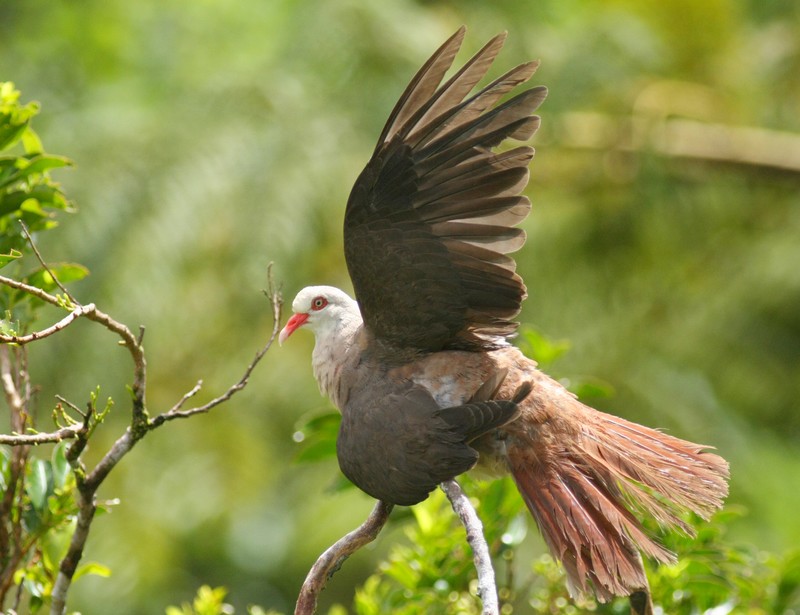
This area holds the biggest sub-population of Echo Parakeets (several 100), but most descent from hand reared birds and almost all birds depend on supplementary feeding. The same goes for the 90 Pink Pigeons around Brise Fer and the 15 around the Petrin visitors center. On the other hand, Brise Fer, Camp field station and the Parakeet Trail are probably the best places in the world to see Mauritius Cuckooshrikes and there is no project assigned to this species, so it is completely tickeable. Maurtius Bulbul also roams these forests. The Brise Fer area is also very interesting for reptile enthusiasts, for it is one of the few places on earth where Upland Day Geckos and Macchabee Skink can be seen, though they are very hard to find.
Female Echo Parakeet (Psittacula eques)

This part of the national park should not be missed, for it offers great views, Mauritius Cuckooshrikes and above all more or less healthy native forests. It might be interesting for photographers to arrange a visit to the field station, for close up views of Echo Parakeet and Pink Pigeon are guaranteed.

Tuesday, March 19, 2013

Mauritius January - July 2013, Bel Ombre Field Station

Bel Ombre MWF field station is located in the south of the national park near the village Bel Ombre. Although trucks regularly pass the field station, is the access to the public rather limited and therefore I will keep this post rather short.

Endemics that can be seen around the field station are Pink Pigeons (40 individuals that depend on supplementary feeding), Echo Parakeets (a small translocated population that depends on supplementary feeding), Mauritius Kestrel (a genuine wild pair, that only depends on a nest box) and Mauritius Bulbul. The Bel Ombre Uppers, a patch of forest a couple of km from the field station, also holds very small numbers of Mauritius Olive White-eyes, Mauritius Fodies and Mauritius Cuckooshrikes, but I have no idea how the public can access this site. I would recommend visiting another site than put energy in trying to see this off limits site...
  Male Mauritius Kestrel (Falco punctatus)

Monday, February 25, 2013

Mauritius January - July 2013, Ile Aux Aigrettes

Iles Aux Aigrettes is The place where most birders tick off Mauritius Olive White-eye and Maurtius Fody. Both of these critically endangered species have been introduced to the island and depend heavily on supplementary feeding, so the purist birders should not visit this island. The same goes for the small population of Pink Pigeons of this island. Besides the endemic birds, MWF has also started translocating White-tailed and Red-tailed Tropicbirds, Wedge-tailed Shearwaters, Sooty Terns and Common Noddies. Of these species, White-tailed Tropicbird are probably the only ones you might see, for wild (or former translocated) individuals regularly fly over the island.
Male Mauritius Fody (Foudia rubra)

Mauritius Olive White-eye (Zosterops chloronotus)

Juvenile Sooty Tern (Onychoprion fuscatus) 
Common Noddy (juvenile) (Anous stolidus)
The island also holds a substantial (introduced) population of Telfair´s Skink and Ornate Day Gecko and now also Guenther´s Day Gecko. Both species are now limited more or less to Round Island and Iles aux Aigrettes is now holding a back-up population which is also used for research. The reptile community on the island also hosts the introduced Aldabra Giant Tortoises, who are being used as analog species for the extinct native Giant Tortoises. Some truly massive individuals can be found here (more than 90 years old)
Ornate Day Gecko (Phelsuma ornata)
Aldabra Giant Tortoise (Aldabrachelys gigantea)
Most birders visit the island because it is easily accissible and the sites where wild Fodies and Olive White-eyes occur are not or barely known.  The island can be reached only by an organised tour. Such a tour can be arranged at the Ecotours office opposite of Pointe Jerome, between Mahebourg and Blue Bay. Special tours can be organised for birders on request, but keep in mind that for the MWF staff it is much more convenient if these are requested in the weekends, for then they will have time to assist you. Anyways, the island is defenitely worth a visit, for it holds the last patch of (restored) coastal forest with loads of critically endangered plant species and walking through this is a nice experience.
Feeding time for the Mauritius Fodies on Ile aux Aigrettes (clip made by Johannes Chambon) 

Tuesday, February 19, 2013

Mauritius January - July 2013, Combo Fieldstation

For four months I have been based at Combo field station, which is situated in the far East of the national park. The forest here is rather lousy and 80% of the trees here are the introduced Syzigium jambos. Although some Black Ebony trees can still be found and one tree species is actually endemic to this shitty forest and all 10 individuals of this species are found here!

For birders this site has special interest for it holds the biggest wild population of Mauritius Olive White-eyes. The population here gets no support apart from predator control and are therefore tickeable, even by the purist. This site also holds amongst others a subpopulation of Pink Pigeons (70 individuals, who receive supplementary feeding), Mauritius Bulbuls and Mauritius Paradise Flycatchers. We even found an abarrent individual that was most likely suffering from an allosome linked pigment deficiency called "Brown", which causes a qualitative reduction in eumelanine, but leaves phaeomelanine untouched. This results in a bleached plumage that turns paler over time as the effected eumelanine degrades in UV light. Signs that distinguish Brown from Leucism or Albinism include normal iris colour, parts that retain a certain amount of colour (caused by phaeomelanine) and most importantly parts of the plumage that are less exposed to sunlight are clearly less bleached. Apart from the avian attractions the forests here hold big roosts of the Mascarene Fruit Bat and they flap over regularly during the day.
7-8 weeks old Juvenile Pink Pigeon (Nesoenas mayeri)
Male Mauritius Paradise Flycatcher (Terpsiphone (bourbonnensis) desolata)
Female Mauritius Paradise Flycatcher (Terpsiphone (bourbonnensis) desolata) with a pigment deficiency called "Brown", which causes a qualitative reduction of eumelanine. Note the less bleached inner primairies and outer secondairies!
Access to this site is rather difficult, but not impossible. Hikes can be arranged through Exsul Lodges and these pass through the field station clearing. I have no idea what hike passes Combo field station (it might be the hike to Piton Savanne), so to be sure to ask Exsul Lodges. If you are not a purist I would not recommend going through all this hassle and just twitch the Olive White-eyes on Iles aux Aigrettes, where sightings are much more common than here.
Female Blue-tailed Day Gecko (Phelsuma cepediana)

Friday, January 25, 2013

Mauritius January - July 2013, Pigeon Wood Field Station

The following posts will be a bit different from the usual site reviews, for most sites were visited while working for the Mauritian Wildlife Foundation as a volunteer on the Pink Pigeon Program. Therefore I spent several months at some sites, who are not or barely open for the "normal" birder. I will try to make the reviews considering these sites as useful as possible.

The first site in the field was the field station called Pigeon Wood. Here I got my training as a Pink Pigeon volunteer. The site is located in the east of the Black River Gorges National Park and holds the second largest Pink Pigeon population (90 birds). For birders, especially the purists among them,  this site should hold special interest, for non of the Pink Pigeons here are translocated and all originate from the last 12 individuals that were found here in the 90ties. However the pigeons of this subpopulation still get supplementary feeding. This area also holds the biggest wild population of Mauritian Fodies. These Fodies are tickeable, even by purists, for here they are not beeing fed or translocated. Other birds of interest in the forests around Pigeon Wood include Mauritius Bulbul, Mascarene Paradise Flycatcher (ssp. desolata, apparently recently split from the nominate subspecies on Reunion) and the ever-present Mauritius Grey White-eye. Other animals of interest are the endemic Blue-tailed Day Gecko and the only native mammal of Mauritius: the Mascarene (or Black-spined) Fruit Bat.
Mauritius Bulbul (Hypsipetes olivaceus)

Female Mauritius Fody (Foudia rubra) carrying nest material (check out those wingbars!)
Adult male Pink Pigeon (Nesoenas mayeri) sunbathing

Mauritius Grey White-eye (Zosterops mauritianus)
Access to this site is a bit difficult, for the track that leads to Pigeon Wood Field Station can only be accessed with a guide. (Contact MWF for more information) This might be annoying, but (very) close up views of Pink Pigeons around the field station are almost guaranteed.
Male Blue-tailed Day Gecko (Phelsuma cepediana)

Saturday, January 19, 2013

Indian Ocean January 2013, Tamatave – Port Louis

The last days before our volunteering on Mauritius began were spent on the Indian Ocean. Instead of flying the Mauritius Shipping Corporation (http://www.mauritiusshipping.intnet.mu/) offers the possibility to go by boat. The crossing takes three days and is cheaper than a one-way ticket, however the Corporation offers only one crossing per month. We paid 250 euro for a one-way ticket in second class and I think it is absolutely worth it. The fare includes all meals (very decent meals) and it gives you the opportunity to see some seabirds. However make sure you don´t get sea sick, for the Indian Ocean is a rough sea. We tried Sea Bands (http://www.sea-band.com/), but we still felt dizzy and nauseous, especially when the ship encountered a tropical storm on the open sea.

We found the open sea between Madagascar and Reunion very, very empty and did not see much, just a single tubenose and some flying fish. This tubenose however deserves special attention. This species is one of the rarest sea birds in the world and breeds on La Réunion. Seeing the species at La Réunion is close to impossible, even though many people claim to have seen one. I´ve spoken a lot with the researchers who work on this species on La Reunion. One of them has worked on them for 11 years and has seen one at sea and had around 10 crashed individuals in his hand. The colony of this petrel is still unknown, but is most likely located in the south of the island. The only realistic, but slim chance of seeing a Mascarene Black Petrel is taking a boat to the sea, preferably between St. Pierre and St. Louis. The best time of the year to do this is between February and April. The researcher who saw a Mascarene Black Petrel here however needed 10 to 15 attempts to succeed. There are even sightings of Mauritius, but these are probably all misidentified dark morph Trindade Petrels (see Round Island). So it is obvious that this species is extremely rare. The only reason that people know that it still exists are the one or two juveniles that are rescued on la Réunion each year. The pictures below show a good candidate Mascarene Black Petrel, according to the scientists, but I´m defenitely not sure and will look into it further. The bird was flying very close to the water with slow, but three to four strong wing beats interspaced by gliding pauses. The bird was rather small and completely dark without any obvious plumage features. Unfortunately it stayed far from the boat and therefore the pictures are rather crappy.
After looking into it further and asking several tubenose specialists for help, it turns out that this bird is most likely a Jouanin´s Petrel. 
Jouanin´s Petrel (Bulweria fallax)
In the right time of the year encounters with whales in this stretch of the ocean are apparently not uncommon and the captain is even willing to stop the boat so the passengers can enjoy these giants for a while. The waters directly around Reunion proved to be more productive with 50 Barau´s Petrels, several hundreds of Tropical Shearwaters and 50 Wedge-tailed Shearwaters. A long stop in the port of Reunion produced also some Mascarene Swiftlets.  Most tubenoses were observed at dusk around Reunion when the birds come back from the sea to the land.
Barau´s Petrel (Pterodroma baraui)
Tropical Shearwater (Puffinus bailloni)
Tropical Shearwaters (Puffinus bailloni)
Wedge-tailed Shearwater (Puffinus pacificus) (pink-billed variant)
I can highly recommend doing this boat trip instead of flying, for it crosses an area rarely covered by birders and who knows what hangs around there. Indian Yellow-nosed and Salvin´s Albatross are definitely among the possibilities. Apart from that, we found our boat, the MS Trochetia, a very comfortable boat, especially compared to Malagasy taxi-brousses.
Open Ocean (picture made by Anna van der Kaaden)

Friday, January 11, 2013

Madagascar November 2012 - January 2013, Lac Kinkony

Just like we started our two months in Madagascar with a bang (see post Madagascar November 2012 - January 2013, Bemanevika Lakes) I wanted to end the trip with a real cracker. A site in Madagascar to do this is Lac Kinkony. Normally the right time in the hear to visit this site is November or begin December, for the roads are still passable and the birds have started breeding. I however visited the lake in mid January and therefore the access was a bit difficult. From Mahajanga I took the boat the Katsepy (5.000 Ariary for a small speedboat or 3.000 Ariary for the large ferry). From there I took a taxi-brousse to Mitsinjo (10.000 - 15.000 Ariary). Be prepared for a very rough ride, for the roads are beyond bad (even worse than the Maroantsetra - Tamatave road). In Mitsinjo everything can be arranged: special permits at the police station (I don´t think they are necessary, but it prevents you from having to bribe police or army men) and guide and boat (the roads from Mitsinjo  to Makary are impassable in January) can be arranged at the Asity office. The right person to help you arrange all these things is Cesar. He also runs the only guesthouse in Mitsinjo. Just ask people in the taxi-brousse to drop you there, everybody knows him. The boat from Mitsinjo to Makary costs around 40.000 Ariary and the rowers deserve every single Ariary of it, for they row five hours straight in 40 degrees Celsius. The boat was a metal one and it is very, very hot inside. A hat, sunglasses and loads of sunscreen are highly recommended. It is possible to go to Makary and back in one day, staying overnight is recommended, for the birds are more active in early morning. For a stay overnight you have to camp out. There are very decent shelters where you can put up your tent (5.000 Ariary for the tent and 2.000 for a guard, but I don´t think that that was really necessary) In the morning I made a small pirogue trip to the lake which produced many lovely encounters includin two Madagascar Jacanas, Purple Gallinule, Little Bittern and the main prize: two adult Sakalava Rails feeding their two chicks!
Sakalava Rail (Amaurornis olivieri)chick
Sakalava Rail (Amaurornis olivieri)
Madagascar Jacana (Actophilornis albinucha)
After the trip I returned to Mitsinjo by rowing boat again for the same fare as the first trip. The boat trips to and from Makary turned out to be very productive with sightings of Humblot´s Heron, Madagascar Pond Heron, Madagascar Sacred Ibis, African Spoonbill, Painted Stork, Comb Duck, Madagascar Pratincole, Caspian Tern, Madagascar Sandgrouse and Barn Owl (ssp. hypermetra).
Humblot´s Heron (Ardea humbloti)
The day I returned from Makary I took the overnight taxi-brousse back to Katsepy and this turned out to be the roughest ride of the entire trip so far. With the visit to this site our trip through Madagascar ended. I think I can say it was one of the most succesfull trips to Northern Madagascar ever, for we saw almost all seldom-seen species (Sakalava Rail, Bernier´s and Helmet Vanga, Amber Mountain Rock Thrush, Madagascar Serpent Eagle, Slender-billed Flufftail, Madagascar Red Owl and Madagascar Pochard). We missed the mythical Dusky Tetraka (despite intensive searching in Marojejy national park) and somehow managed to miss Cryptic Warbler. Unfortunately Scaly Ground Roller and Brown Mesite were only heard (despite seven days of very intensive searching for both species). The two months yielded 175 bird species in total and over 30 mammal species and I am highly content with this result. This island is a truly magical place and I am genuinely looking forward to my next visit to this country so I can complete my list of endemics.
Madagascar Swamp Warbler (Acrocephalus newtoni)

Travelling birders equipment and its maintenance

As a small intermezzo I want to make a post about the equipment I use in the field on my travels. I will also post a small note on its maintenance, for that subject should not be forgotten on long travels. I will write a small review on each piece of equipment I carry at the moment. My total photographic and sound recording equipment consists of:
  • Two pairs of waterproof binoculars (Bynolyt Tern 10x45 and Pentax 9x32 DCF BC)
  • Canon 40D
  • Canon 1100D
  • Canon 300 mm F4.0 USM L (old version without IS)
  • Canon teleconverter 1.4 II
  • Tamron 17-50 mm F2.8 XR Di II (old version without VC)
  • Canon 18-55 F3.5-5.6 EFS IS II
  • Sony PCM M10 sound recorded including windcover and bag
  • RadioShack Mini Amplifier/speaker including AUX cable, backup AUX cable and backup 9V battery 
  • Zen Style MP3 player 4GB including basic headphones
  • 2 backup BP511 batteries for 40D
  • 1 Backup LP-E10 battery for 1100D
  • 2 SanDisk Ultra CF cards 8GB 30 MB/s
  • 1 SanDisk Ultra CF card 4GB 15 MB/s
  • 4 Transcend Micro SD cards 4GB Class 10
  • Asus Eee 10" Notebook
  • Samsung S2 Portable 500GB 2,5" external hard drive
  • CorsAir Survivor 8GB USB Stick
  • Basic CF card reader
  • Basic SD card reader
  • Basic blower
  • Sensor Swab travel kit including cleaning fluid, 4 swabs, 2 microfiber cloths and a moist microfiber cloth
  • 200 grams of silica gel
  • Toothbrush with soft brush
  • Ortlieb 12L waterproof bag
  • Optech Rain sleeve
  • Vanguard Uprise 48 camera bag
  • LowePro Apex 120 AW camera bag
Me, making a sound recording of Madeira Firecrest (Regulus madeirensis) (picture taken by Anna van der Kaaden)
Of almost every single piece of equipment listed above I am very happy about I took it on a two year trip. However it took a long time of saving, preparing, considering, reading and informing before I finely got to this selection. Below I will review every single piece of equipment. (keep in mind that I am in Mahajanga, Madagascar right now and don't have a lot of access to professional reviews, so my reviews are strictly personal and highly unprofessional)
  • Two pairs of waterproof binoculars (Bynolyt Tern 10x45 and Pentax 9x32 DCF BC): We use two basic pairs of waterproof bins. One B-brand (Bynolyt Tern), which has a metal body and is therefore quite heavy but seems indestructible (it survived my (not so gentle) handling for the last seven years) and one C-brand (Pentax DCF BC), which is lighter, but also very robust. Both fulfill their purpose. Of course I would have preferred a Swarovski, but I do not have the money for that an I can't bear the thought of having a brand-new Swarovski snatched away from me by some street kid...
  • Canon 40D: I have been using this camera for various travels and I am fairly content with it. I very much like the fact that the body is made of magnesium alloy and not of the lighter, but more vulnerable, "plastic". However the traveling is beginning to have its affect on the camera and the release button refuses to cooperate on rare occasions. Also the info button does not respond at all times and makes contact at some random moments. Besides that, the camera works perfectly, but looks heavily beaten with some spots where no paint whatsoever is left. For people with a little more budget I would advice buying a Canon 7D (or Nikon D7000, which is more or less the equivalent) which is much better isolated than the 40D and thus more resistant against dust and moisture, which is probably the reason for my electronic problems. Besides this, the 7D preforms much better in low light conditions (like in a rainforest) due to its much better ISO values. It is also a lot faster than the 40D. I think a 7D is an ideal travel camera for birdwatchers, but on the other hand, if a beat-up, old, second-hand 40D gets stolen, it is not as bad as if this would happen to a brand new 7D...
  • Canon 1100D: We bought this camera new just before our departure as a camera for travel snapshots. It fulfills its purpose precisely, although a high quality compact camera like a Canon S95 or G12 would do equally well without the extra weight and size of the 1100D. However if the 40D got be stolen, we would have this one as a back-up. Beware however, the Canon 1100D is just a very basic DSLR and consequently quite vulnerable to shock, sand, dust and moisture and not very fast.
  • Canon 300 mm F4.0 USM L (old version without IS): I am highly content with this lens. I use the old model without the IS, which is apparently the "worst thing" of the new lens and the older model is according to the "experts" even a bit more sharp. Besides, under (very) rough travel conditions, which are our everyday life at the moment, it will be the first thing to break anyway. The lens is fairly small for a wildlife photography lens, which means it is also quite light and does not take up to much space in my camera bag and that gives me the opportunity to put other things in the bag besides one lens. 300 mm does not seem a lot, but with a crop camera these become 480 mm (or 450 if you are a Nikonist). Besides 300 mm gives you the opportunity to shoot at fairly low shutter speeds (I still get sharp images at 1/150 second on some occasions). The animals in the tropics we have encountered so far were very often very tame, so no need for a 800 mm in my humble opinion. In the jungle the 4.0 maximum aperture can become a problem, but the 300 mm 2.8 lens is three times as expensive and twice as heavy, so it will stay a dream for me, for now. 
  • Canon teleconverter 1.4 II: For the rare occasions things are little to far away and can not be approached I bought this converter. It proved to be very useful on boat rides and ferry crossings were animals are often further away. I experience no loss of quality when using the converter, however the speed of the 300 mm decreases slightly. In the jungle the thing is quite useless for you loose one stop, thus a lot of light, meaning much longer shutter speeds. I bought version II for the difference in quality between I and II seemed rather large and between II and III rather small. Version III is also 150 euro's more expensive an I don't think 3% better glass is worth that. However, annoying is the fact that version II has rubber isolation only on one side (God knows why) and III on both sides, which makes the contacts between converter and lens vulnerable.
  • Tamron 17-50 mm F2.8 XR Di II (old version without VC): Like with the 300 mm we bought the older version for the same reasons. Above that, the "experts" state that this lens is apparently much sharper than the new one with VC. This lens is a hundred times sharper than the kit lens and preforms much, much better under bad light conditions and is not much more expensive. Besides, this lens is also much more robust with metal (probably a magnesium alloy) body and rubber coating., which makes it for me a very decent travel lens and a good alternative for the crazy expensive Canon equivalent.
  • Canon 18-55 F3.5-5.6 EFS IS II: Just the basic kit lens. We only took it because we had it and to act as a back-up for the Tamron 17-50 mm  F2.8 and for the very rare occasions we both wanted to make travel snapshots. (which we actually did sometimes!) I would recommend almost every other lens instead of this one, but it is a cheap back-up.
  • Sony PCM M10 sound recorded including wind cover and bag: For somebody who is new in the sound recording world (like me) this is an awesome little gadget. It has two microphones (resulting in high quality recordings), seems unaffected by moisture and best of all: it has a pre-rec function. Unfortunately I often forget to make use of this great function. It is also quite cheap and very small and portable. The wind cover is a great addition (although ridiculously expensive for a piece of fabric). This piece of equipment fist perfectly in a Crumpler JackPack 90, which gives you the opportunity to carry it on your belt and be able to use it very quickly. I am very glad I bought this item and made already 120 decent recordings, some of which are even new for www.xeno-canto.org. Soon the sound recordings will be available on this blog as well.
  • RadioShack Mini Amplifier/speaker including AUX cable, backup AUX cable and backup 9V battery: Supposedly the best of the best for birders (http://www.birdsounds.nl/index.php?pg=productsitem&gr=0&id=798&jsd=1), mostly because of its resilience , but I already managed to destroy it. Luckily I could fix it with duct tape. I am fairly content with it. It does the job, but nothing more. I advice you to always carry a back-up AUX cable, for I already thrashed a very thick one. Always carry a back-up battery as well.
  • Zen Style MP3 player 4GB including basic headphones: I use this MP3 player for personal use as well for tape-luring birds. Therefore I had some requirements when buying an MP3 player: small, a micro SD slot, easy to handle, not to easy to break and cheap. This MP3 player has all of these characteristics and consequently I am very happy with it. The Micro SD with the bird sounds on it work fantastic with this player. 
  • 2 backup BP511 batteries for 40D: Two back-up batteries turned out to be perfect: I always know which one is full and which one is not and never have no full battery left. The original Canon batteries are better and work significantly longer, but are also ridiculously overpriced.
  • 1 Backup LP-E10 battery for 1100D: Just one back-up is enough for our travel snapshot camera. The same thing goes for these batteries as for the BP511.
  • 2 SanDisk Ultra CF cards 8GB 30 MB/s: Decent sized cards with a data transfer fast enough for a 40D. More professional cards require faster cards.
  • 1 SanDisk Ultra CF card 4GB 15 MB/s: A very basic back-up card. Not used until now, but 15 MB/s is sometimes too slow for a 40D.
  • 4 Transcend Micro SD cards 4GB Class 10: Decent, fast Micro SD cards which I use for tape, as back-up memory for my Sony PCM M10, to learn Russian and improve my French (using Pimsleur). Four might have been one to much, but an extra backup is never wrong and they don't weight much.
  • Asus Eee 10" Notebook: I did not bring a notebook on our trip, but it turned out to be very handy, so we bought one for a reasonable price in Antananarivo, Madagascar. It is small, light and the battery lasts long enough. The Monitor could have been of better quality though. (I don't know much about computers so this review is much shorter than it should have been. Luckily there is something called Google)
  • Samsung S2 Portable 500GB 2,5" external hard drive: At first we wanted to buy an expensive, shock and waterproof hard drive (http://tweakers.net/pricewatch/276265/lacie-rugged-usb-30-500gb-oranje/specificaties/), but they were out of stock for several months, so we opted for a cheaper, more basic one (http://tweakers.net/pricewatch/231134/samsung-s2-portable-500gb-zwart/specificaties/), which is still alive. I am content with it, for it is light, small and has a large enough storage capacity. Always keep it in a waterproof bag though, just to be sure.
  • CorsAir Survivor 8GB USB Stick: Fairly useless back-up option due to its tiny storage capacity but virtually indestructible, unless being shot at by an assault rifle. 
  • Basic CF and SD card reader: We took the most basic and small ones which turned out to be just fine and we use them weekly. They are fast enough, for me at least. No use for a USB 3 in the third world anyway...
  • Basic blower: I bought a small manually operated rubber blower to remove dust from the camera sensors without the need to use one of my few swabs. It is very cheap, light and handy, but unnecessary on a short trip.
  • Sensor Swab travel kit including cleaning fluid, 4 swabs, 2 microfiber cloths and a moist microfiber cloth: Not used until now, but I will probably have to in very near future. Practice at home with some one who knows how to do it, before you do it yourself during travels, for you might damage your sensor. The microfiber cloths are indispensable. I bought an extra large one (31x31 cm) from Sigma, which I am very content with. The moist microfiber cloth is completely useless and it is a mystery to me why anyone would clean a lens or, worse, a sensor with a methanol containing cloth. I threw it away a long time ago. 
  • 200 grams of silica gel: Completely unnecessary. I will probably discard it in near future. Silica gel works only in air tight spaces, so it would be useful if all electronics are kept in a waterproof bag for most of the time. This is however very unhandy, due to the long time it takes before your equipment can be used.
  • Toothbrush with soft brush: Extremely useful! Every photographer should carry one while traveling. It is the easiest way to clean your camera and lenses with (not the glass and sensor of course). 
  • Ortlieb 12L waterproof bag: Very very handy and highly recommended! Ortlieb might be expensive, but they really are the best. Our other waterproof bags have holes already, but this one still is like new, even though it almost melted in an overheating car. 12 L is large enough to fit all my 40D with 300 mm and 1.4 convertor and a Sony PCM M10 in and it all still can fit perfectly in the normal way into my camera bag. I think it probably can contain all my electronics with ease. Maybe a 7 L would have been enough, but I wanted to be sure.
  • Optech Rain Sleeve: A decent, simple rain sleeve for camera and lens (up to 400 mm) that I saved for the boat trip from Madagascar to Mauritius, but it wasn't necessary on this voyage so I can't really state wether or not it is usefull.
  • Vanguard Uprise 48 camera bag: Decent, large camera bag, divided into two compartments: one with five smaller compartments for (camera) equipment and one for miscellaneous. It has a special side way opening for quick camera access. It is broad enough for a 40D with 1.4 converter and 300 mm to fit in horizontally. all equipment can fit in this bag, but makes it very heavy (10 kg). The rain cover, which is located in a small compartment in the back padding, making it asymmetrical and caused me severe back aches for several weeks (better to put it in the laptop compartment), is completely worthless. After little more than three months traveling and regular use the cover is completely destroyed and rotting. A shame, for now I have to use my raincoat instead of covering myself with it.
  • LowePro Apex 120 AW camera bag: Very decent, small camera bag with very decent rain cover, although mostly used in another bag for extra protection. Therefore no more comments than this.
Me, photographing an Ethiopian Bushcrow (Zavattariornis stresemanni), Yabello, Ethiopia (picture taken by Anna van der Kaaden)
As travels on low budget can be extremely rough in Africa and Asia I clean my gear at least once a month entirely, but more often when necessary, which it mostly is. I still should do it more often, I think, for the amount of dust, lichens, moss, pieces of leaves, dead ants etc. removed from, primarily my 40D is immense. I also blow the dust out of my camera, or at least I try, every month. All glass is cleaned with more regularity. For this I advice to use only DRY microfiber cloths and never moist microfiber cloths, for they tend to leave a residue on your glass. The methanol could also have long term effects on coating. The same goes for moist paper cleaning "towels": they are even worse and the paper fibers can scratch the coating of your glass work. 

In the end all maintenance during travels is probably fairly rudimentary and you will end up breaking your stuff anyway, but it gives me the feeling that I can postpone that God-awful date a little. 


Me, photographing a Crab Plover (Dromas ardeola) in Pongwe, Zanzibar, Tanzania (picture taken by Anna van der Kaaden)
For any questions, do not hesitate to mail or comment, but I am not sure I can answer the technical questions.

Monday, January 7, 2013

Madagascar November 2012 - January 2013, Betsiboka Delta

In Ankarafantsika national park I got a phone number of a trustworthy boatman in Mahajanga. This made it possible for me to visit the Betsiboka Delta. This delta is The site for Bernier´s Teal and Madagscar Sacred Ibis. The boatman I used turned out to be really trustworthy (Iango, 0332551418 or 0325169149). The total prize of visiting the right area for the specialities in the delta is not cheap. I  paid close to 200.000 Ariary and that included fuel and motor oil. However, for this prize you get an entire day of searching with an experienced boatman who knows the area and the birds, but he speaks little english. We were quite unlucky with the ducks, for it took us very long (8 hours) to find them and we got stuck in a sandbank that surprised Iango.

In the end we saw four Bernier´s Teals, two Madagascar Sacred Ibisses, one Humblot´s Heron and many waders including 250 Crab Plovers. We also observed pleasing numbers of Saunder´s Terns who showed very well and I managed to actually identify some by their plumage and not just by range.
Part of a large group of Crab Plovers (Dromas ardeola)
Saunder´s Tern (Sternula saundersi) (look at those primairies!)
Madagascar Sacred Ibis (Threskiornis bernieri)
Bernier´s Teal (Anas bernieri)
For birders this place is a must, but a logistical pain in the ass due to tides, boats, boatmen etc. and the area itself is not that special, so for any non birder I would recommend not to spend the large sum of money to visit Madagascars biggest delta.