Showing posts with label Sumba. Show all posts

Wednesday, September 17, 2014

Sumba 2014 - Pantai Cemara

Our last two days on Sumba were spent at Pondok Wisata at Pantai Cemara (Cemara Beach). Mainly because we wanted to enjoy the beach and relax a bit. This hotel can be easily reached from Waingapu. The hotel arranges pick-up from Waingapu (or the airport) and drop off. Both are included in the hotel price. We paid IDR 585.000 for a standard room including breakfast which was quite fair as this is a fancy place.

We still did some birding around the hotel, next to relaxing. This turned up some noteworthy things. Of main interest were the two tame Malaysian Plovers that could be observed at close range just in front of the hotel. We also did a bit of sea watching, but this produced little, just some Greater Crested Terns and a Green Turtle. On the hotel grounds itself we found Pied Bush-chat, White-shouldered Triller, Timor Zebra Finch, Scaly-breasted Munia and Lemon-bellied White-eye to be common. Behind the hotel there were some mangroves, in which we found several Sunda Teals, Common Sandpiper, Barred Dove, Common Kingfisher (ssp. floresiana), Rainbow Bee-eater and Indonesian Honeyeater. We also put some time in searching for Tailorbirds, as Birdquest has found some weird looking Tailorbirds (possibly escapees, but who knows...) a bit closer towards Waingapu. Unfortunately we did not find any.
Male Malaysian Plover (Charadrius peronii) just in front of the Pondok Wisata hotel.
We did enjoy this place a lot as the beach is nice, the food is good and the rooms are beautiful and comfy. It is a good place to have a small break from birding, but not completely as some interesting things can be found around the hotel.

Tuesday, September 16, 2014

Sumba September 2014, Manapeu-Tanah Daru national park

This is the largest national park of the island (it goes from km 63 to km 97 and all the way down to the South coast) and holds several patches good quality forest and all endemic bird species (and subspecies) can be seen here. From several trip reports I read and Burung Nusantara it appears that access to this national park is a bit complicated as there office is located in Kupang and so some birders enter the park “illegally”. We had no problems at all, for we asked Mama Kati (006285239910745) from our homestay to help us with this matter and within 15 minutes a young guard of the national park was standing before us. He introduced himself as Sam (006281238943833) and turned out to be very friendly and with a lot of knowledge, both about the local avifauna and the sites were to find him. We arranged everything through him: 100.000 IDR for the ojeks (for the whole day, so a good price in my opinion), 100.000 IDR guiding fees, 10.000 IDR entrance fees (per person per day) and 25.000 IDR camera fee (per camera per day). Currently the entrance fees are still cheap, but most likely they will change in 2015. Like in Kelimutu national park the fees are going to be 150.000 IDR per person per day on a weekday and 225.000 IDR per person per day on a Sunday, making the birding here a lot more expensive…

We visited several sites within the national park. We started at 05:00 and drove all the way to km 88 (an area also known as Lokuhuma). Exactly at the km 88 marker there was a path leading to a viewing point (there is even a yellow sign stating this), where one has a good view on several patches of forest. We walked the path for 15 or 20 minutes and arrived at the hill. Within five minutes we had distant but decent views of three Yellow-crested Cockatoos of the distinct citrinocristata subspecies. Later it turned out that there were not three but seven Cockatoos! After this success we moved a little further to scan for Parrots, Hornbills and Pigeons. We scanned the trees for some time and got good views of several Great-billed Parrots, Red-cheeked Parrots and Green Imperial Pigeons as wells as some distant views of two Marigold Lorikeets. Unfortunately we found no hornbills so we moved back to the hill where we had seen the Cockatoos. After a while we heard a single Sumba Hornbill, but it stayed in the valley and we did not manage to see it. A Green Junglefowl that flew up into a tree in front of us and started calling was very entertaining on the other hand. On the way back we flushed a Brown Quail, saw several Broad-billed Flycatchers and got more looks at Great-billed Parrots. Furthermore we got charged by an angry free ranging steed, which was fended off by Sam. Consequently we were glad we had visited this site the official way and had a national park guard on our side who knew how to deal with this!
Male Red-cheeked Parrot (Geoffroyus geoffroyi)
Two Citron-crested (Yellow-crested) Cockatoos (Cacatua (sulphurea) citrinocristata) flying over a valley
Broad-billed Flycatcher (Myiagra ruficollis)
After our early morning visit to km 88 we drove to an area called Langgaliru, which is more commonly referred to as km 68-72. Birding here is done simply from the roadside, which means a lot of honking from passing vehicles, a feature I still cannot appreciate. There are some tracks that lead into the forest but these are generally scarce. We hoped to find the Hornbills we had missed earlier here as well as Sumba Myzomela, Sumba Brown and Sumba Flycatcher. We did not find these targets, but saw several other good species including Short-toed Eagle, Black-naped Fruit-dove, Marigold Lorikeet and Spectacled Monarch. As soon as it got hot we returned to the homestay for a delicious lunch.
Adult Short-toed Eagle (Circaetus gallicus)
We visited Langgaliru (km 68-72) again in the afternoon to give our diurnal target species another try. After a 10 minute drive we arrived at the forest and found it very silent. In the end we failed again to find our targets, but on the other hand I got ridiculous good views of an Elegant Pitta and my girlfriend even found two! We didn’t even use playback to find them as they betrayed their presence by the sound of rustling leaves while they hopped and foraged on the forest floor. All individuals were incredibly tame and did not mind our presence at all. We also got some views of Ashy-bellied White-eye and Eclectus Parrot along the road together with some more common forest species.
Elegant Pitta (Pitta elegans maria)
At dusk we decided to give the Hornbill a last try and so we moved to km 65 were some scrubby forest is left. Before we even got of the ojek a Sumba Hornbill was flying over the road! In the end we saw four individuals here, of which two allowed rather close views. We again enjoyed ridiculously good views of Elegant Pittas here, by tracing them in the same fashion as before.
Sumba Hornbill (Rhyticeros everetti)
Male Sumba Hornbill (Rhyticeros everetti) in flight
The next day we returned to Langgaliru (km 68-72) to search for our remaining diurnal targets: Sumba Myzomela, Sumba Brown and Sumba Flycatcher. We left at 05:30 and at km 65 I realised that I forgot my binoculars. I left my girlfriend at the scrubby forest, where we had seen the Sumba Hornbills the day before and went to the homestay to collect my bins. When I returned I found out she already had had a pretty good morning in which she saw a male Green Junglefowl, a Black Kite, a Sumba Hornbill, two Elegant Pittas and an unidentifiable Flycatcher! We continued our way to km 69 and started searching for the remaining targets. Luckily the day turned out to be a pretty good one for me as well. A Sumba Flycatcher was found quickly inside the forest as it was singing. Later we found three more! After a bit of searching the brightly coloured Sumba Myzomela was seen several times at a flowering tree. We went to a tree with a large hole in it, were normally Sumba (Australasian) Barn Owl can be seen roosting. As Short-tailed Starlings entered the hole it was clear to us the Owl was currently not at home. However it was no shame that we waited half an hour at near this tree as two Sumba Brown Flycatchers showed perfectly in a tree in front of it! All diurnal targets were seen by now and we birded a bit further along the road enjoying views of Variable Goshawk, Orange-footed Scrubfowl (found in the same fashion as we found all those Elegant Pittas), Metallic Pigeon, Black-naped Fruit-dove, Eclectus Parrot, Elegant Pitta, Pale-shouldered Cicadabird, Sumba (Russet-backed) Jungle-flycatcher and Spectacled Monarch amongst others.
 
Black-naped Fruit-dove (Ptilinopus melanospilos)
Sumba Flycatcher (Ficedula harterti)
Sumba Brown Flycatcher (Muscicapa segregata)
In the evening we returned to km 65 to do some owling. When we arrived we noticed that a considerable part of the scrubby forest was on fire… It turned out that a farmer wanted to burn his grassland to stimulate the growth of fresh grass started a fire nearby and that got out of hand due to strong winds. We heard later that these fires are currently the biggest threat to wildlife on Flores as hunting and wildlife trade has been put to an end here by the national park guards. We drove to the far western edge of the scrubby forest, as far away from the fire as possible, and started to search for night birds. While we waited for the darkness to set in we found some more Elegant Pittas here! Our main target however was Sumba Boobook. We tried at several sites along the road and inside the forest but we never got more than a short series of coughs as a response. Little Sumba Boobook was equally unwilling to play. We also heard a Sumba (Australasian) Barn Owl and noticed a Savannah Nightjar flying over. A bit disappointed we returned to our homestay. Perhaps the owls were a bit skittish due to the fire close by…

We enjoyed birding in this national park a lot, although I still can’t get used to birding next to a busy road. We did not have any trouble with the national park and in fact, I think the national park guards are doing great work. I also think that it is a bit silly to try to enter the national park “illegally” just to avoid paying the fees. It is in the advantage of the national park and the birds if money gets generated by visiting birders, even if the money you pay does not go to the national park itself.
 Find the Elegant Pitta (Pitta elegans)! (video made by Anna van der Kaaden)

Sumba September 2014, Km 51

This decent patch of forest, which is named after the kilometre marker on the trans-Sumba road, is famous for being a good spot to locate some of the forest endemics of Sumba, with the advantage of being outside of the national park. This means it comes with no extra costs, just the ojek from Lewa to get you there. Lewa is a good place to base yourself in while birding the interior of the island and can be easily reached from Waingapu (1.5 hour drive) or Tambolaka. We stayed at the birder-friendly homestay that is being run by Mama Kati (006285239910745), which we can highly recommend. It currently costs 300.000 IDR per person per night including three massive and delicious meals. Mama Kati can arrange everything from busses and ojeks to access to the national park, so basically everything to make the birding you are dying to do so actually happen. Also her guestbook holds a lot of information about the birding sites. Furthermore her garden holds Indonesian Honeyeater, Apricot-breasted Sunbird, Yellow-spectacled White-eye and Pale-headed Munia. Just make sure to call her in advance when staying here.
Apricot-breasted Sunbird (Cinnyris buettikoferi) showing it's apricot breast at Mama Kati's Homestay

We arranged ojeks through Mama Kati to get from Lewa to km 51 for 50.000 IDR during the day and 75.000 IDR at night for the drop-off and pick-up. The ride takes 15 to 20 minutes and the ojek drivers that Mama Rewu arranges know the track that leads from the trans-Sumba road through grasslands to the forest patch. If you use another ojek driver look for a single house around km 51 on the Southside of the road (the right side when coming from Lewa). Behind that house (to the East) is a dirt track that leads to a patch of forest clearly visible in the south. Keep to the left on the track and within 15 minutes you will find yourself in a patch of degraded, but bird-wise interesting forest.

We birded this patch of forest twice, one morning and one evening, and saw a lot of interesting species including some endemics. After arriving at 6:45 at the track we birded this area until 11:00. After this it got very hot here and consequently the bird activity dropped considerably. When arriving at the edge of the forest we kept further to the left and followed the track through the forest, where we flushed an Elegant Pitta. This track leads to a big clearing where we spent quite a lot of time as it is a strategic place to search for perching pigeons in the morning as you can scan the treetops all around you at ease. We waited but 30 minutes and found a Red-naped Fruit-dove perched in one of the trees. What a beauty! A bit later we also found a second individual and two Sumba Green-pigeons that bolted out of the trees as soon as I raised my binoculars. Other interesting species observed at the clearing included Brown Goshawk, Black-naped Fruit-dove, Rainbow Bee-eater, Sumba (Russet-backed) Jungle-flycatcher Blood-breasted Flowerpecker of the distinct wilhelminae subspecies and Apricot-breasted Sunbird. We also heard many Cinnamon-banded Kingfishers calling, but did not find any at the clearing. We also found two Australian Koels here.
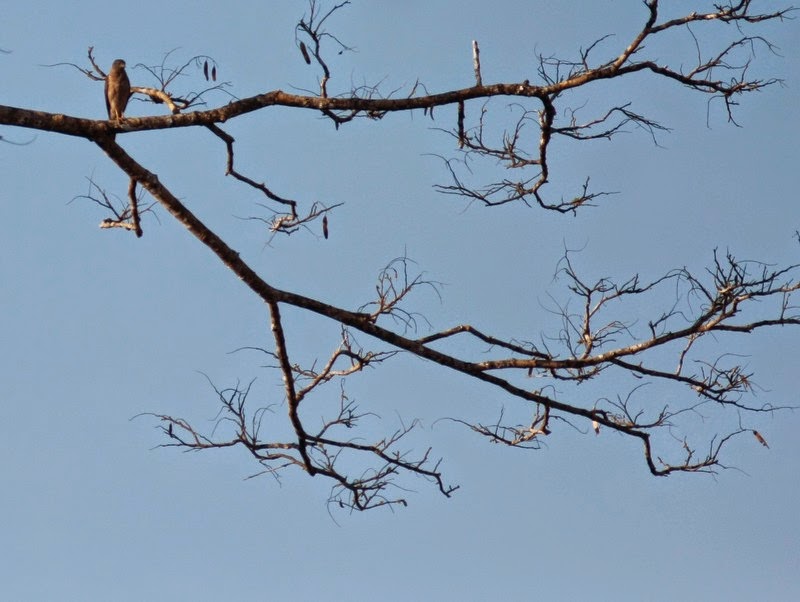
Adult Brown Goshawk (Accipiter fasciatus)
One of the two stunning Red-naped Fruit-doves (Ptilinopus dohertyi) seen
Male Australian Koel (Eudynamys orientalis)
After we had our share at the clearing we entered the forest on several sides of the clearing, mainly searching for flycatchers and Cinnamon-banded Kingfisher. Of the latter we got some fairly decent flight views. More interestingly however, my girlfriend actually managed to find three or four Red-backed Buttonquails on the ground and after waiting a short while they showed themselves brilliantly foraging just a few meters away from us completely in the open! If only it was possible to see Sumba Buttonquail in this fashion! Furthermore we also saw an Orange-footed Scrubfowl running through the forest, what luck! Other species of interest that were observed in the surrounding forests included Sumba (Wallacean) Drongo, Wallacean Cuckooshrike (which we found by following the begging calls of juvenile), Yellow-spectacled White-eye and Arafura Fantail (one individual actually tried to land on my head!).
Female Red-backed Buttonquail (Turnix maculosus) foraging out in the open!
Female and Juvenile Wallacean Cuckooshrikes (Coracina personata) (video made by Anna van der Kaaden)

In the evening we returned to this site again and walked straight to the clearing to search for nightbirds. We waited until it was properly dark and while doing so Cinnamon-banded Kingfisher, Elegant Pitta and Helmeted Friarbird where calling from everywhere. After a short wait a Mees’s Nightjar flew past without calling (the complete opposite of the birds we observed in Kisol, Flores, who did not want to shut up at all) and most unexpectedly: a Sumba (Australasian) Barn Owl glided past. When it was completely dark three or four Little Sumba Boobooks started calling, but none of them wanted to play. The actually more or less all fell silent as soon as we started the playback… We tried within the forest and at the forest edge again, but no response, from either Little Sumba or Sumba Boobook.

We enjoyed birding this patch of forest a lot, as it is easy to reach on your own and the birding is interesting and entertaining. Furthermore, it appears to be most reliable site to see the stunning Red-naped Fruit-dove.

Monday, September 15, 2014

Sumba September 2014, Yumbu Grasslands

The grasslands beyond the village of Yumbu are a well-known site for the only endemic on Sumba that cannot be found within the forests, Sumba Buttonquail. The site is located roughly 15 km East of Waingapu and can easily be reached from here. We arranged ojeks from Waingapu to the Yumbu bridge (jembatan Yumbu in Bahasa Indonesia) for 100.000 IDR including waiting time, which was a fair price I think.

We arrived at the bridge around 07:00 and decided that the grasslands East of the bridge (beyond the bridge when coming from Waingapu) looked more promising than the grasslands West of the bridge (before the bridge when coming from Waingapu) and started our searches on the North side (the left side of the road when coming from Waingapu). It took a while before we flushed the first Buttonquail here but at least it allowed some fairly decent views, showing a greyish face and rusty-brown flanks enabling us to positively identify it as a Sumba Buttonquail. We also found a big family group of Brown Quails in this area that allowed absolutely stunning views while standing completely in the open.
Brown Quails (Coturnix ypsilophora)
After an hour we crossed the road and decided to check the South side (the right side of the road when coming from Waingapu) for another hour, as I had read in trip reports that Sumba Buttonquail is more common on ridge on this side of the road, even though the grasslands look not so good. We flushed two buttonquails here rather quickly and later another two. My girlfriend even saw one on the ground for a few seconds. Of those four, three could be identified positively as Sumba Buttonquail, while one looked rather pale. It seems to me that Sumba Buttonquail prefers grasslands mixed with bare rock, but perhaps this side is less disturbed than the North side… We also saw a Spotted Harrier in the area, next to some more common species like Timor Zebra Finch, Barred dove, Red Avadavat, Australasian Bush lark and White-shouldered Triller.
Spotted Harrier (Circus assimilis)
Timor Zebra Finch (Taeniopygia guttata)
Barred Doves (Geopelia maugei)
Australasian Bushlark (Mirafra javanica)
We enjoyed searching for Sumba Buttonquail at this site a lot, not just because we found them but also because the view from the ridge on the South side is quite nice and it was not as hot as we had expected. However I think it might also be a good idea to search for the buttonquails in the afternoon, as you are likely to get dropped at the bridge and then walk towards the East. This means that during the morning the light is not so great at first, but better during the return journey to the bridge. During the afternoon this situation would be the opposite.
A flock of Timor Zebra Finches (Taeniopygia guttata) flying over the Yumbu Grasslands (video made by Anna van der Kaaden)