 |
| 1 ky Asian Brown Flycatcher (Muscicapa dauurica) |

A conservationist's birding blog promoting ecotourism abroad to reinforce local conservation and restoration efforts
Tuesday, October 22, 2013
Vietnam August - October 2013, Ho Chi Minh City
Since we were more or less stuck for quite some time in Ho Chi Minh City I started to do some birding within the city. Especially after seeing some posts on http://vietnambirdnews.blogspot.com/ about migrants in Hanoi, I wanted to give the zoo in Ho Chi Minh city a try. It has quite a lot of large trees and might prove interesting for birds that are not in a cage. The zoo is located in district one and therefore very easy to access above all the entry fee is only 8.000 VND. We birded the zoo for three hours accumulating over four Ashy Minivets, 30 Asian Brown Flycatchers, two leucogenis Ashy Drongos and over 20 Yellow-browed Warblers, but unfortunately no other migrants.
It was clear that the migration in the south had not yet reached the same magnitude as in Hanoi. Other birds included Green-billed Malkoha, Black Drongo, Collared, Common and White-throated Kingfisher, Lesser Necklaced and White-crested Laughingthrush and Coppersmith Barbet. The zoo looks good for migrants, but will probably prove to be more productive later in the year.

Tuesday, October 8, 2013
Vietnam August - October 2013, Ngoc Linh
After seeing the first endemic of the Kontum plateau (Chestnut-eared Laughingthrush) we set out with Bao to do some exploring, in the hope of becoming the first birding crew to complete the Kontum trio. Recently a new road has been built along the southern slopes of mount Ngoc Linh, where the mythical Golden-winged Laughingthrush is found. The laughingthrush was reported to occur between 2.000 and 2.200 MASL on Ngoc Linh, but also occurs on Ngoc Boc to south of Ngoc Linh and that mountain is only 1.800 MASL. The new road,which starts at Tumorong and will lead in the future all the way to Quang Ngai province, only reaches an elevation of just above 1.500 MASL. However, the road passes through some really good quality high montane forest, which looked exactly the same as the the forest on Ngoc Linh on higher elevations.
We set out to check out the forest and the area on the first day, so we could decide our strategy. After all this area has probably never been birded before. Unfortunately on our first exploration drive we got stuck in a mud hole in the road, whose quality ranges from Dubai highway to virtually non-existent. The car was so stuck that a truck could not pull it out and after five to six hours of trying, we had to abandon car for the night. After a very interesting night at a local house we went back to the car with a bigger truck and managed to pull it out of the swamp. However lady luck was still not on our side as it rained all day (apparently it had rained here for a month non-stop). We explored one trail which produced not much, but an unidentified laugher flying over the trail, but unwilling to show itself was enough to keep our spirits high. Furthermore we recorded Pygmy Cupwing, Plumbeous Water Redstart and White-crowned Forktail.
Luckily the next day it was beautiful weather and we enjoyed stunning scenery and good birding. We tried both roadside birding and checking out forest trails up to 1.670 MASL, but in the end we were not successfull in locating a Golden-winged Laugher. The highlight of the day was a Black-crowned Barwing that was found in a patch of degraded forest along the roadside. This sighting might prove to be quite important as it is only the second area where this species is found (the first being the northern slopes of Ngoc Linh including the Lo Xo pass). Other highlights included several Red-tailed Laughingthrushes and White-winged Magpies. Mixed species flocks where diverse and entertaining. They held Clicking and Green Shrike Babblers, Red-tailed Minla. Rufous-winged Fulvetta (of the endemic stepanyani subspecies), Fork-tailed Sunbird, Large Niltava, Yellow-billed Nuthatch, Grey-crowned Tit, Grey-crowned, Grey-cheeked and Chestnut-crowned Warbler and Annam Barbet amongst others. While the sky prooved good for Black Eagle, Crested Serpent Eagle, Shikra, Oriental Honey Buzzard and Silver-backed Needletail. Stangely enough we only recorded one mammal, which was an unidentified squirrel.
I really think that this area might hold some Golden-winged Laughingthrushes, but obviously one day in the wet season, without local knowledge is not enough to locate it. Apparently it is only dry here between March and May, so another try in that time of the year might prove more fruitful. The forest is still very nice and exciting things are just waiting to be found. The locals for example recognised Crested Argus and Cutia in the book. However the site is still very remote and more or less a restricted area for foreigners, although they seem to be less strict about it here then on the northern slopes of the mountain, for we had barely any trouble. We were only advised by locals to turn around at the altitude of 1.670 MASL for we might get problems with the authorities. So when visiting this site please be careful and do not bring the locals in jeopardy. Furthermore, I think visiting this site without a guide is unwise, because nobody speaks any english and you might want a translator if you get into trouble with the authorities. Regarding the accomodation, there is a small hotel in Tumorong which is only 30 km from the forest, that offers very decent rooms, but the locals might also be willing to invite you into their homes. Concluding, I highly recommend this site, but with the right consideration and preparation.
 |
| Satellite picture of the new road leading to the southern slopes of Ngoc Linh |
Luckily the next day it was beautiful weather and we enjoyed stunning scenery and good birding. We tried both roadside birding and checking out forest trails up to 1.670 MASL, but in the end we were not successfull in locating a Golden-winged Laugher. The highlight of the day was a Black-crowned Barwing that was found in a patch of degraded forest along the roadside. This sighting might prove to be quite important as it is only the second area where this species is found (the first being the northern slopes of Ngoc Linh including the Lo Xo pass). Other highlights included several Red-tailed Laughingthrushes and White-winged Magpies. Mixed species flocks where diverse and entertaining. They held Clicking and Green Shrike Babblers, Red-tailed Minla. Rufous-winged Fulvetta (of the endemic stepanyani subspecies), Fork-tailed Sunbird, Large Niltava, Yellow-billed Nuthatch, Grey-crowned Tit, Grey-crowned, Grey-cheeked and Chestnut-crowned Warbler and Annam Barbet amongst others. While the sky prooved good for Black Eagle, Crested Serpent Eagle, Shikra, Oriental Honey Buzzard and Silver-backed Needletail. Stangely enough we only recorded one mammal, which was an unidentified squirrel.
 |
| The highlight of our visit to Ngoc Linh: discovering a new site for Black-crowned Barwing (Actinodura sodangorum) |
 |
| Red-tailed Laughingthrush (Garrulax milnei) |
 |
| White-winged Magpie (Urocissa whiteheadi) |
 |
| Crested Serpent Eagle (Spilornis cheela) |
 |
| Black eagles (Ictinaetus malayensis) are always cool to see |
Monday, October 7, 2013
Vietnam August - October 2013, Mang Den
Just like the previous site, Mang Canh was visited by us together with my dear friend Bao from Vietnam Birdwatching. The main reason for our visit to this site is the rare, localised and endemic Chestnut-eared Laughingthrush, that was found here by Bao a couple of years ago. The only other site for this bird is Mount Kon Ka Kinh that is off limits for foreigners and moreover it has not been seen there for a while. Because we reached this site by private transport I have no idea how to reach this site by public transport. It should be possible to reach the town of Mang den, where the closed accomodation to Mang Canh is found, by bus from Kontum and take a motorbike to Mang Canh forest (which is a 45 minutes drive from the town).
We stayed in the area for three nights, but had limited time to do good birding due to heavy rains. Even though we managed to get brilliant views of the Chestnut-eared Laugher on our second day in the midst of heavy rains! We had to work hard to get views and had about ten non-cooperating individuals before we finally saw some feathers! But the area holds more goodies and we recorded Bar-backed Partridge, Besra, Annam Barbet, Blue-bearded Bee-eaters, Silver-backed Needletail, White-winged Magpie, Indochinese Green Magpie, Ratchet-tailed Treepie, White-capped Water Redstart, Yellow-billed Nuthatch, Sultan Tit (ssp. gayeti) Rufous-faced Warbler, Grey-crowned Tit, Grey-headed Parrotbill and Black-hooded Laughingthrush.
We also enjoyed some first migrants like Asian Brown Flycatcher, Yellow-browed Warbler, Pale-legged Leaf Warbler and Arctic Warbler. We missed Pale-capped Pigeon and Northern Brown Hornbill, but that was probably because our birding time was rather limited, for both species are rare in the area and it is more a matter of luck of finding them. Mammals recorded included Cambodian Striped and Black Giant Squirrel.
We stayed in the area for three nights, but had limited time to do good birding due to heavy rains. Even though we managed to get brilliant views of the Chestnut-eared Laugher on our second day in the midst of heavy rains! We had to work hard to get views and had about ten non-cooperating individuals before we finally saw some feathers! But the area holds more goodies and we recorded Bar-backed Partridge, Besra, Annam Barbet, Blue-bearded Bee-eaters, Silver-backed Needletail, White-winged Magpie, Indochinese Green Magpie, Ratchet-tailed Treepie, White-capped Water Redstart, Yellow-billed Nuthatch, Sultan Tit (ssp. gayeti) Rufous-faced Warbler, Grey-crowned Tit, Grey-headed Parrotbill and Black-hooded Laughingthrush.
 |
| Sultan Tit (Melanochlora sultanea gayeti) |
 |
| Grey-headed Parrotbill (Paradoxornis gularis) |
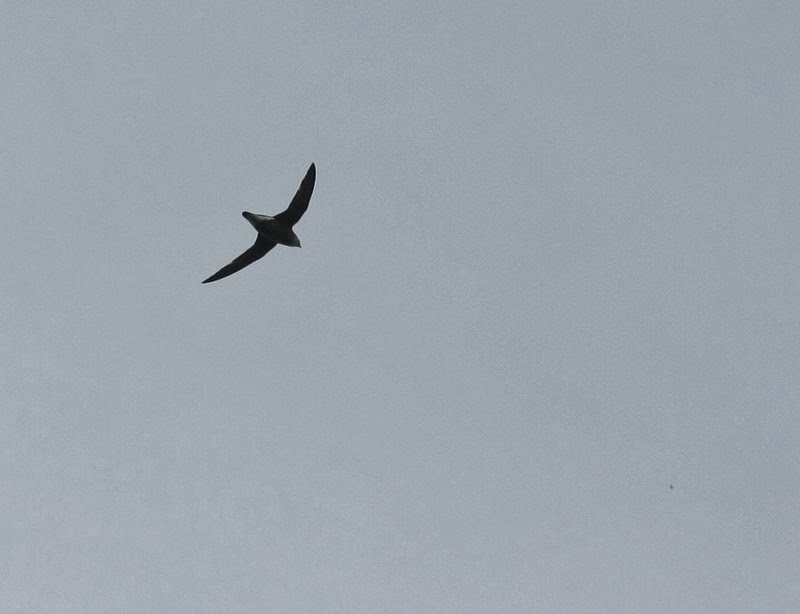 |
| Silver-backed Needletail (Hirundapus cochinchinensis) zooming overhead |
 |
| Pale-legged Leaf Warbler (Phylloscopus tenellipes) |
 |
| Arctic Warbler (Phylloscopus borealis) |
Vietnam August - October 2013, Yok Don National Park
This national park is rarely visited by birders, for the area that holds the real goodies like Masked Finfoot, Giant Ibis, White-shouldered Ibis, Red-headed Vulture and White-headed vulture is completely off limits for foreigners. The area that can be visited holds species that can also be seen in Cambodia. The main highlights are Mekong Wagtail, White-rumped Pygmy Falcon and Neglected Nuthatch. We visited this site on a Birdwatching Vietnam Tour with my friend Bao, so I don´t know much about the accessibility of this site by public transport, but it shouldn´t be too difficult.
We only spent one afternoon and one morning in the park, for we were mostly just passing through on our way to Mang Den (see next post). On the afternoon we saw Mekong Wagtail and Stork-billed Kingfisher in the Ban Don tourist area. In the evening we did some owling around the Ban Don lodge, where we spent the night, which resulted in some glimpses of a Brown Boobook. Owling here can be very productive as Oriental Scops Owl, Brown Fish Owl and Savannah Nightjar can all be seen here.
 |
| Male Mekong Wagtail (Motacilla samveasnae) |
The next morning we birded the dry dipterocarp forest around the Ban Don lodge and observed Black-hooded Woodpecker (very common), Greater Yellownape, Grey-capped Pygmy Woodpecker,Oriental Pied Hornbill, Asian Barred Owlet, Green Imperial Pigeon, Collared Falconet, Black-hooded Oriole, Spangled Drongo, White-browed Fantail and Grey-faced Tit-babbler amongst others. Unfortunately we missed the Pygmy Falcon and the Nuthatch.
 |
| Black-headed Woodpecker (Picus erythropygius) |
When travelling over the inland road, I highly recommend a stop at this site, but maybe not for longer than one or two nights, for the area that is accessible is not that big and the birding might get boring.
Tuesday, September 17, 2013
Vietnam August – October 2013, Bach Ma National Park
This site, known for several range
restricted specialities, is not for the easily frustrated. Most birds are shy,
elusive and hard to see. Moreover the
logistics within the park are not ideal for birdwatchers. The park is situated 45 km south of Hue and
the gateway town to the park, Cau Hai can be easily reached by public transport.
4 km further are the headquarters of the park, where apparently accommodation
is available, but requesting this was most bewildering to the staff so we
stayed at the “villa” at KM 17. There is only one road within in the park and
all trails start from here. This area can be divided into three areas: low, mid
and high altitude forest, of which the first and the last are the most
interesting for birdwatchers.
We birded four days in Bach Ma, or at least
we tried, but lady luck was not on our side. Most of the time the weather was dominated by dense fog
and heavy rains for a typhoon was raging on the South Chinese Sea... The
consequence was that only one day was invested in birding the lower elevations
and the rest of the time we birded at higher elevations. The biggest speciality
at higher elevations is the range-restricted and near-threatened Indochinese
Wren-babbler (formerly called Short-tailed Scimitar-babbler), which was seen
twice (one pair at KM 18 and one pair on the Rhododendron trail). The main road
between KM 16 and KM 19 is good for huge mixed species flocks which held Sultan
Tit (ssp. gayeti), Indochinese Yuhina
(formerly part of the Striated Yuhina complex), Ratchet-tailed Treepie (once),
Indochinese Green Magpie (once), Black-throated and Lesser Necklaced
Laughingthrush, White-browed Scimitar-babbler, Fork-tailed Sunbird,
Silver-eared Mesia, Orange-bellied and Blue-winged Leafbird and Red-headed
Trogon. Huge flocks (>200) of Pin-tailed Parrotfinches were also observed.
Around the “villa” Blue-rumped Pitta, Red-collared Woodpecker and Rufous-throated Partridge remained
heard-only. This area can also provide productive night birding, for we heard Hodgon´s Frogmouth, Mountain Scops Owl and Brown Wood Owl. Black Eagle
and Mountain Hawk Eagle were observed soaring overhead, whilst Crested Serpent
Eagle could join the ever growing list species that remained heard only.
Interesting mammals included the rare Red-shanked Douc Langur, Southern White-cheeked Gibbon, Pallas´ Squirrel
and Maritime Striped Squirrel. The park also hosts the rare and recently
discovered Saola, but chances of seeing this beautiful antelope are equal to
seeing a unicorn...
 |
| Indochinese Wren-babbler (Jabouilleia danjoui) |
 |
| Ratchet-tailed Treepie (Temnurus temnurus) |
 |
| Part of a huge Pin-tailed Parrotfinch (Erythrura prasina) flock |
 |
| Black Eagle (Ictinaetus malayensis) |
 |
| Mountain Hawk Eagle (Nisaetus nipalensis) |
On the last day the weather was more
friendly and I drove down with Nhan, the parks only bird guide (0914052575), on
a motorbike (350.000 VND). The Pheasant trail is the only trail giving acces to
the lower elevations, which hosts a whole bag of goodies. However the trail is
situated at KM 8, thus 9 km from the
“villa” and 5 km from the park headquarters. Obviously one day was not enough
to hear Crested Argus (I don´t know of any Western birder that has seen this
gigantic, but elusive bird). Strangely enough it was three years ago Nhan heard
Crested Argus… Are they getting even more rare? One day was also not enough to
see or hear the endemic Annam Partridge (keep in mind that this taxon may prove
not to be a valid species after all). However just two Sultan Tits (ssp. gayeti), one Blue-rumped Pitta
sighting and another calling individual appeared to be not a good catch to me.
The Bar-bellied Pitta´s didn´t give a peep! We also did not walk all the way to the river at the end of the trail, for Nhan said this area to be not good birding-wise, but later I learned that this area might yield Blyth´s Kingfisher. Furthermore we were lucky enough to
stumble upon a Sun Bear in the afternoon so we got the hell out of there before
the afternoon activity kicked in… Red-shanked Douc Langurs were also observed along the Pheasant trail. The Trees around the entrance gate used to be a reliable spot for Brown Fish Owls, but the trees were cut so we also missed this species. Apparently one can still see them in the evening around the headquarters, but we were not there at that time of the day.
My advice for this park: Do not go in this time of year, invest much time in the Pheasant trail, particularly in the early hours of the day, but do not forget the higher elevations and bring your own transport.
 |
| A crappy record shot of the endemic gayeti subspecies of Sultan Tit (Melanochlora sultanea) which might be elevated to species levels |
My advice for this park: Do not go in this time of year, invest much time in the Pheasant trail, particularly in the early hours of the day, but do not forget the higher elevations and bring your own transport.
Friday, September 6, 2013
Vietnam August - Oktober 2013, Con Dao National Park
Situated in azure waters and clad in primairy evergreen and mangrove forests, Con Dao is a pristine tropical archipelago that is barely visited by Western tourists and even less by birders. However it hosts some specialities that only breed here within Vietnam like Pied Imperial Pigeon, Nicobar Pigeon and Brown Booby. Apart from the birds it is also an important breeding ground for sea turtles, making it highly interesting as an ecotourism destination. The island can be reached by a one hour flight from Saigon (70$) or by boat from Vung Tau.
We spent three nights on the biggest island, Con Son, and one on Bai Canh island. Accomodation on Con Son is widely available but on Bai Canh you can only sleep at the field station of the conservation workers. We arranged our visit to Bai Canh island at the national park office for 1,645,000 VND per person including boat, food, drinks, snorkeling equipment and a hammock at the field station. The main reason to go here is to see sea turtles, who come here between April and November to lay their eggs. At the field station there is also a big hatchery where you can see the little ones hatching. At high tide (between 23:00 and 04:00) you go to the beach to see the female turtle laying eggs. We saw this phenomenon once, but with luck more turtles can be observed. Two species of turtles nest here. The vast majority are Green turtles but occasionally a Hawksbill Turtle is seen as well. It is also possible to see the Dodo´s closest living relative, the Nicobar Pigeon, on Bai Canh, but make sure to state that you want to walk from the field station through the forest to the lighthouse to get a chance to see this species. Otherwise it is a turtle-only trip. We didn´t do the hike and therefore saw not many birds on Bai Canh apart from some Roseate Terns, Whimbrels and Pacific Reef Egrets along the shore and some White-rumped Shama´s and Stripe-throated Bulbuls in the mangroves.
On Con Son are also sites where Nicobar Pigeons can be seen, so we spent a lot of time searching for the elusive birds, but in the end with no luck. We first walked to Bang Beach so we could also have a look at Thre Nho Island which apparently hosts Brown Boobies, but none were around. The next day we walked through So Ray forest which is indeed of very good quality but again no Nicobar Pigeons. Later we walked to Ong Dung Beach with the same result. Pied Imperial Pigeons however can hardly be missed and were seen constantly flying from one mountain to the other and were even observed flying over the village. Other birds of interest included: Edible-nest Swiftlet, Ermerald Dove, Dark-sided Flycatcher, Forest Wagtail and White-bellied Sea-eagle. The most surprising observation was however a calling Blue-rumped pitta next to the path to Bang Beach. Unfortunately it did not want to play and remaind heard-only.
For mammal and reptile enthousiasts the archipelago offers some specialities like the endemic Pulocondore Bow-fingered Gecko and the endemic subspecies of Black Giant Squirrel and Long-tailed Macaque. We also observed loads of Finlayson´s Squirrel, Northern Three Shrew and some unidentified bats. Dugongs are occasionally observed in the waters, especially in March and April. Apart from the endemic gecko and the sea turtles we also observed Tokkay Gecko and Ornated Garden Lizard.
Con Dao was an awesome place to be and the turtle watching was quite an experience. However birding here is not that exciting as the forest are empty even though they are of good quality and birding is there for rather slow.
We spent three nights on the biggest island, Con Son, and one on Bai Canh island. Accomodation on Con Son is widely available but on Bai Canh you can only sleep at the field station of the conservation workers. We arranged our visit to Bai Canh island at the national park office for 1,645,000 VND per person including boat, food, drinks, snorkeling equipment and a hammock at the field station. The main reason to go here is to see sea turtles, who come here between April and November to lay their eggs. At the field station there is also a big hatchery where you can see the little ones hatching. At high tide (between 23:00 and 04:00) you go to the beach to see the female turtle laying eggs. We saw this phenomenon once, but with luck more turtles can be observed. Two species of turtles nest here. The vast majority are Green turtles but occasionally a Hawksbill Turtle is seen as well. It is also possible to see the Dodo´s closest living relative, the Nicobar Pigeon, on Bai Canh, but make sure to state that you want to walk from the field station through the forest to the lighthouse to get a chance to see this species. Otherwise it is a turtle-only trip. We didn´t do the hike and therefore saw not many birds on Bai Canh apart from some Roseate Terns, Whimbrels and Pacific Reef Egrets along the shore and some White-rumped Shama´s and Stripe-throated Bulbuls in the mangroves.
Video of hatching Green Turtles (Chelonia mydas). Made by Anna van der Kaaden
 |
| Juvenile White-rumped Shama (Copsychus malabaricus) |
On Con Son are also sites where Nicobar Pigeons can be seen, so we spent a lot of time searching for the elusive birds, but in the end with no luck. We first walked to Bang Beach so we could also have a look at Thre Nho Island which apparently hosts Brown Boobies, but none were around. The next day we walked through So Ray forest which is indeed of very good quality but again no Nicobar Pigeons. Later we walked to Ong Dung Beach with the same result. Pied Imperial Pigeons however can hardly be missed and were seen constantly flying from one mountain to the other and were even observed flying over the village. Other birds of interest included: Edible-nest Swiftlet, Ermerald Dove, Dark-sided Flycatcher, Forest Wagtail and White-bellied Sea-eagle. The most surprising observation was however a calling Blue-rumped pitta next to the path to Bang Beach. Unfortunately it did not want to play and remaind heard-only.
 |
| Pied Imperial Pigeon (Ducula bicolor) |
 |
| Dark-sided Flycatcher (Muscicapa sibirica) |
 |
| Pulocondore Bow-fingered Gecko (Cyrtodactylus condorenis) |
 |
| The endemic condorensis subspecies of Black Giant Squirrel (ratufa bicolor) |
 |
| Northern Tree Shrew (Tupaia belangeri) |
 |
| Unidentified insectivorous bat |
Tuesday, August 27, 2013
Cambodia August 2013, Angkor Wat and Tonle Sap
Unfortunately I spent only four days in this lovely country and my time here was mostly spent more or less twitching Angkor Wat. I did not do much birding, but still visited two sites of interest and maybe this post will still be useful to somebody.
We did two days of sightseeing in Angkor, visiting a large array of temples. Around the temples we still saw some birds as the complex is located in decent dry dipterocarp forest. Birds observed included Cotton Pygmy Goose, Greater Racket-tailed Drongo, Red-breasted Parakeet and Bronze-winged Jacana. The best area for birdwatching within the Angkor Wat boundaries is however the small patch of good dry dipterocarp forest at Kbal Spean. Unfortunately we visited this area during the middle of the day saw therefore few birds, amongst them: Ruby-cheeked Sunbird, Black-naped Monarch, Great Iora and Pin-striped Tit-babbler. This area could prove productive for Neglected Nuthatch has been sighted here.
On the last day we did a boat ride to the "flooded forest" at Tonle Sap. At first we wanted to visit Prek Toal Bird Sanctuary but according to http://www.samveasna.org/ are the key species (Greater Adjutant, Lesser Adjutant, Spot-billed Pelican and Milky Stork) not around during this time of year. Thus we refrained from the expensive boat ride ($110 per person) and made a cheaper boat ride. This still resulted in a distant sighting of several Spot-billed Pelicans, many Black Bitterns, Oriental Pratincoles, some Darters and Painted Storks and a single Black-headed Ibis.
Like I said, my "twitch" of Angkor Wat did not do this country justice birdingwise and I would love to come back and do a proper trip to see all specialities.
We did two days of sightseeing in Angkor, visiting a large array of temples. Around the temples we still saw some birds as the complex is located in decent dry dipterocarp forest. Birds observed included Cotton Pygmy Goose, Greater Racket-tailed Drongo, Red-breasted Parakeet and Bronze-winged Jacana. The best area for birdwatching within the Angkor Wat boundaries is however the small patch of good dry dipterocarp forest at Kbal Spean. Unfortunately we visited this area during the middle of the day saw therefore few birds, amongst them: Ruby-cheeked Sunbird, Black-naped Monarch, Great Iora and Pin-striped Tit-babbler. This area could prove productive for Neglected Nuthatch has been sighted here.
On the last day we did a boat ride to the "flooded forest" at Tonle Sap. At first we wanted to visit Prek Toal Bird Sanctuary but according to http://www.samveasna.org/ are the key species (Greater Adjutant, Lesser Adjutant, Spot-billed Pelican and Milky Stork) not around during this time of year. Thus we refrained from the expensive boat ride ($110 per person) and made a cheaper boat ride. This still resulted in a distant sighting of several Spot-billed Pelicans, many Black Bitterns, Oriental Pratincoles, some Darters and Painted Storks and a single Black-headed Ibis.
 |
| "Flooded forest" at Tonle Sap. Picture made by Anna van der Kaaden |
Saturday, August 17, 2013
Myanmar July – August 2013, Hlawga Park
This site, situated 90 minutes drive from
Yangon, is the easiest place in the world to see the davisoni race of Stripe-throated Bulbul which has a high split
potential. If split, it will be a new endemic for the country. It also used to
be a site for Pale-capped Pigeon, but I don´t know of any recent records. We
visited this site as a daytrip from Yangon by taxi. We paid K 30.000 for going
to the park from Yangon, one drive through the park and back to the Hotel,
stopping at a WWII memorial, because we had to see the nice flowers according
to our driver. The entrance fee is K 800 per person and K 1.000 per vehicle.
The park was one of the weirdest places
I´ve ever birded. The only interesting bird I´ve seen here was a male Green
Peafowl that was walking around the entrance gate and allowed ridiculous
close-up views, giving a rather zoo-like feeling. Apparently this species was
re-introduced 12 years ago, so not countable for the purist, but if you can
count Pink Pigeons and Mauritius Fodies on Iles Aux Aigrettes, than you can
count these Peafowls. As soon as we were in the park we were surrounded by
hundreds of Rhesus Macaques who were jumping up and down to be fed, which the
locals do very regularly. This resulted in a rather hurried drive through the
park, trying to get rid of the monkeys. At last I made a small walk that
yielded White-throated Kingfisher, Common Iora and Olive-backed Sunbird and to
my astonishment two wing-clipped Spot-billed Pelicans! After fifteen minutes
however the macaques returned and I went back into the car, for I hate
half-tame monkeys. During the rest of the drive through the park we saw nothing
special, but more (re)introduced species like Gaur, Sambar and Hogdeer.
 |
| A very wild male Green Peacock (Pavo muticus) |
Obviously we did not see any Pale-capped
Pigeons or Stripe-throated Bulbuls and I wonder how Birdquest manages to see
them (the bulbuls) and get them into a scope without dozens of macaques
bothering them. I would not recommend going to this site for it is basically
somewhat of a badly managed safari park with a lot partying youth in it as well
in the afternoon.
Saturday, August 10, 2013
Myanmar Juy – August 2013, Kyaiktiyo Wildlife Sanctuary
Just like our visit to the Moeyungyi
Weetlends, our visit to Kyaiktiyo Wildlife Sanctuary was mostly insired by the http://birding.sstmyanmar.com/kyaikhtiyo-wildlife-sanctuary. Mount Kyaiktiyo is
mostly famous for its Golden Rock Pagoda at its top, but there are apparently
some reasonable forests on the mountain. We based ourselves at Kinpun Base
Camp, from which we walked up the mountain on the first day towards the Maha
Myaing Paya. First you pass through a lot of cleared forest and later through
crappy secondary forest. Here we only found a Black-necked Laugher and some
Crested Treeswifts.
The next day we took one of the trucks
taking the pilgrims up the mountain in the hope to find better forest at higher
altitude. We decided to walk down from the Golden Rock back to Kinpun. First
you pass countless vendors, but later there are some patches of secondary
forest which contained amongst others Vernal Hanging Parrot, Green-billed
Malkoha, Blue-winged Leafbird, Crested Goshawk, Buff-breasted, Puff-throated
and Striped Tit Babbler, Lesser Necklaced Laugher, Little Spiderhunter and
Lesser Rufous-headed Parrotbill.
Even though we saw some interesting
species, I don´t understand why this is a “wildlife sanctuary”. Maybe we did
not find the right trails and birded in the wrong places, maybe the time of the
year was not right, but in my opinion the human pressure on the forests here
seems just too much. It still is an interesting site from a cultural
perspective, but the fact that foreigners have to eat and sleep at specially selected
places and are completely separated from the local people creates a weird
atmosphere.
 |
| Ridiculously large butterfly (Attacus atlas) |
Monday, August 5, 2013
Myanmar July – August 2013, Moeyungyi Wetland Sanctuary
Since the main birding spot of the country,
Mount Victoria, is unreachable in the rainy season (roads are apparently
impassable) and it is extremely costly to arrange a visit (around $800 per
person), we had to find some other destinations in Myanmar to fill the 28 days
we had planned here. First we had planned to go to Myitkyina and to do a boat
trip down the Ayeyarwaddy River, but after seeing the completely full river in
Bagan, we let this idea go, for it would have been, birding wise, a rather
boring four to six days.
Therefore we resorted to other birding areas off the standard tour itineraries. One of them is the Moeyungyi Wetland Sanctuary near Bago. I found on http://birding.sstmyanmar.com/moeyungyi-wetland-bird-sanctuary that this is a reliable site for Sarus Crane, a species I missed at Inle Lake. So we arranged a motorbike for 12.000 MKK in Bago to go to the wetlands and then we paid $25 for four canoes to go on the lake. We saw barely any birds during this boat trip, for the wetland areas were completely flooded. Most interestingly were four Painted Storks and some Asian Golden Weavers. We showed a picture of Sarus Crane to some local farmers and they knew the bird very well, but they only saw them in the dry season here. Other birds that can be observed here include Cotton Pygmy Goose, Grey-headed Swamphen, Bronze-winged Jacana and Oriental Pratincole (according to SST Tourism). I think for this site it makes a huge difference whether you visit it in the wet or the dry season and I advise checking this site out in the dry season, for it sounds definitely interesting.
Therefore we resorted to other birding areas off the standard tour itineraries. One of them is the Moeyungyi Wetland Sanctuary near Bago. I found on http://birding.sstmyanmar.com/moeyungyi-wetland-bird-sanctuary that this is a reliable site for Sarus Crane, a species I missed at Inle Lake. So we arranged a motorbike for 12.000 MKK in Bago to go to the wetlands and then we paid $25 for four canoes to go on the lake. We saw barely any birds during this boat trip, for the wetland areas were completely flooded. Most interestingly were four Painted Storks and some Asian Golden Weavers. We showed a picture of Sarus Crane to some local farmers and they knew the bird very well, but they only saw them in the dry season here. Other birds that can be observed here include Cotton Pygmy Goose, Grey-headed Swamphen, Bronze-winged Jacana and Oriental Pratincole (according to SST Tourism). I think for this site it makes a huge difference whether you visit it in the wet or the dry season and I advise checking this site out in the dry season, for it sounds definitely interesting.
 |
| Flooded area as far as the eye reaches... No birds at all... (picture made by Janne de Hoop) |
Subscribe to:
Posts (Atom)