Monday, August 1, 2011

India July - August 2011, Srinagar

We left Ladakh by the only other motorable road. This road leads through the Zanskar area, which is just as marvellous as the previous valleys we visited, and leads in the end to the capital of Kashmir: Srinagar. We spent a couple of days in this disputed area, but remained unfortunately only inside the city. The lake in the city, on which one can sleep in boats (quite expensive though), offers fairly decent birding and we enjoyed our stay there.

Birds observed on the lake included many Indian Pond, Black-crowned Night, Little, Cattle and Great Egret, Common, Pied and White-throated Kingfisher, Black, White-winged and Whiskered Tern, Citrine Wagtail and Clamorous Reed Warbler. The biggest surprise however was a 1kj Red-headed Bunting male in between a dozen of House Sparrows. The yellow rump was seen well and it also had a red-brown hue on the head, excluding Black-headed Bunting.
1kj male Red-headed Bunting (Emberiza bruniceps). Note the reddish hue on the head and the still very fresh plumage.
Common Kingfisher (Alcedo atthis)
White-throated Kingfisher (Halcyon Smyrnensis)
Pied Kingfishers (Ceryle rudis)
I hope I can come back to this disputed area to try for the three endemics. I regret I did not have time to search for them during this trip, so I highly recommend that people visiting Ladakh, don´t forget to give Kashmir a try, because the people here are very nice and we had no problem at all during our stay and the birds here included some endemic and mythical species! The best trip would be of course to start in the Great Himalayan National park for Western Tragopan and Cheer Pheasant, than go to Ladakh and finish in Kashmir with an Orange Bullfinch. We keep dreaming!

Thursday, July 28, 2011

India July - August 2011, Khardung La and Nubra Valley

Khardung La is one of the (often falsely claimed as the) highest motorable passes in the world. The highest point of the pass is above 5.600 MASL. We wanted to check the pass out and combined it with the stunning Nubra Valley, that lies behind. We did both by bicycle, however, if you want to so you need a van to take you up to the pass, unless you are extremely fit (ascending from 3.500 to 5.600 is no joke) and so we did and it was extremely enjoyable.

Besides the scenery we also enjoyed some decent birds, especially on Khardung La. Goodies included Tibetan Snowcock (up to a meter next to the van) and a female Grandala (Unfortunately no male). Other birds which were also observed on other high altitude passes included White-winged (or Gueldenstaedt´s) Redstart and Horned Lark (ssp. longirostris). Around the pass we also observed several groups of Wild Yaks.
 A crappy record shot of a Tibetan Snowcock (Tetraogallus tibetanus), but a reasonable picture when considering it was taken with a 55 mm lens. Yes, we were close!
In the Nubra Valley we did not do much birding, but some interesting birds were still observed like Hume´s Whitethroat, Common Rosefinch and Chukar. I think there are good birding spots in this area, for BirdQuest also visits this area, but none were known to me at that time, so better research might yield better species.
Common Rosefinch (Carpodacus erythrinus)

Tuesday, July 26, 2011

India July - August 2011, Tso Kar

After doing some research I found out that Tso Kar, one of the three largest lakes in Ladakh, might yield some very good species. Local people confirmed this, so we tried to set out to this site. This is a very remote site and we therefore tried to find other backpackers to join in, but since Pangon Tso is much more popular with the "normal" tourists we failed to find anybody wo was interested. In the end we had to rent a van for two days for the price of roughly $100. The price is this high, because it takes four to five hours to get there and the worlds second highest pass is on the route, making it not the easiest way to drive.

We birded the area for an afternoon and a morning and this yielded some stunning and rarely seen species including the rare Black-necked Crane and the seldom-seen Tibetan Sandgrouse, which turned out to be rather common here! Other species included Ruddy Shelduck, Brown-headed Gull, Upland Buzzard, Lesser Sand Plover (in breeding plumage and performing the famous broken-wing strategy to distract me from its nest!), Hume´s Lark, Spotted Great Rosefinch (split from Great Rosefinch in the Caucasus)  and Hoopoe.Tibetan Snowfinch and Tibetan Wagtail were surprisingly common. Waders were also common with Red-wattled Lapwing, Common Redshank, Green Sandpiper, Wood Sandpiper and Temminck´s Stint amongst others. Apparently Groundpecker can also be seen in the area, but we did not find them unfortunately. We however did see some very large larks flying in the distance, but the were to far away to indentify them. This site is also an interesting site for mammals. Kiang, or Tibetan Wild Ass, is common in the area. The site is apparently also good for Grey Wolves.
A pair of Black-necked Cranes (Grus nigricollis) with a single chick
Male and female Tibetan Sandgrouse (Syrrhaptes tibetanus)
Tibetan Sandgrouse (Syrrhaptes tibetanus) in flight
Lesser Sand Plover (Charadrius mongolus)
Male Spotted Great Rosefinch (Carpodacus severtzovi)
Kiang (Equus kiang)
This site is truly spectacular. The numbers and the tameness of the Tibetan Sandgrouse alone make this place worth visiting. Beside that a lot of other good birds and mammals can be seen here. However when visiting this site, be prepared to either camp out or sleep in a very basic hut, which, in my opinion, makes the entire experience even better.
A swamp and lake lined by 7.000+ mountains, what more does a man want? (picture taken by Guido Bonthond)

Sunday, July 24, 2011

India July - August 2011, Hemis National Park

Once in Leh we set out to do a multiple day trek into Hemis National Park to enjoy the vastness of the Ladakhi area. We decided to do a trek through the Rumbak area. This is a four to five day trek, but managed to this trek in three days although this required a considerable amount effort. At first we wanted to do the eight days Marka Valley Trek, but we did not have enough time to do this. We skipped the first day of the trek, by taking a taxi into the mountains, for the first day of trekking goes from Leh to the first village inside the national park and during that first day the area that you pass through is rather dull and not very interesting birding wise. The same goes for the way back to Leh at the end of the trek. Once you exit the National Park, the scenery is still stunning, but the trekking is not as nice, so we hitched a ride back to Leh.

During the three days of hiking we enjoyed a lot of good birds and mammals as well as absolutely breathtaking scenery and amiable Ladakhi locals. Birds observed during those days in the Hemis area included Himalayan Snowcock, Himalayan Griffon,Golden Eagle, Lammergeier, Wallcreeper, Chukar, Robin Accentor, Brown Accentor, Alpine Accentor, Asian House Martin, Grey-backed Shrike, Tickells Leaf Warbler, Plain Mountain Finch and Streaked Rosefinch. During second and last day of the trek we also passed through some areas that looked pretty good for Himalayan Rubythroat and White-browed Tit-warbler, but we had no succes in finding these superb birds.
Plain Mountain Finch (Leucosticte nemoricola)
Robin Accentor (Prunella rubeculoides)
Female Wallcreeper (Tichodroma muraria)
Male Streaked Rosefinch (Carpodacus rubicilloides)
Part of a group of Himalayan Snowcocks (Tetraogallus himalayensis)
Brown Accentor (Prunella fulvescens)
Tickell´s Leaf Warbler (Phylloscopus affinis) of the newly described perflavus subspecies
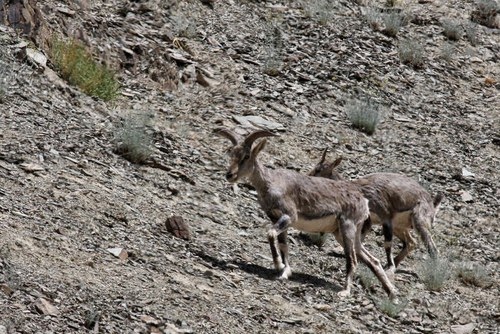
Mammals observed here included real (!) Wild Yaks, Blue Sheep, Himalayan Marmot and Ladakh Pika. This is also the best place in the world to look for Snow Leopards and even BirdQuest has started to organise tours to this area to see this incredible creature. We looked for three days for this species, but according to the locals the Snow Leopards can only be found above 5.000 MASL during the Arctic Summer, so the best time to go would be in September or October, when the mountain peaks are starting to become colder. Even though, during our second night in the area we heard a large cat attacking cows in a local village at night. So it must have been either a Snow Leopard or a Lynx, Lynxes are apparently much rarer in this area..
Blue Sheep (Pseudois nayaur)
Himalayan Marmot (Marmota himalayana)
This area is absolutely one of my favorite places on earth. It is wild, remote, full of life if you know where to look, barely populated and the people that do live here are incredibly nice. So when visiting the Ladakhi area a trek through the Hemis national park should be considered as a must!
Trekking in Hemis is not always easy, but the scenery never disappoints!

Wednesday, July 20, 2011

India July - August 2011, Spiti Valley

Ladakh can be reached by three ways. The easiest way is to fly straight to Leh, but there are two other much more interesting ways to travel to this remote corner of the world. Both ways lead through even more remote areas and both deserve some attention. Coming from Delhi, the most logical choice is to travel over land via Manali to Leh, but we took a detour through the incredible Kinnaur and Spiti valleys in Himachal Pradesh. We did not spend much time in the Kinnaur valley, which is probably just as interesting as the Spiti Valley, but the extreme remoteness of Spiti was unresistable, so we spent roughly a week in what turned out to be my most favourite part of this wonderfull country so far.

We based ourselves in Kaza, which was a small and very quiet town back then, but I´m afraid that the area has been discovered by backpackers and will soon be a bustling tourist town. We did some birding just outside of the town. To the east of the town flows the majestic Spiti river, which looked like a perfect site for Ibisbill and Solitairy Snipe, but despite intensive searching we did not find them, probably due to the overkill of suitable habitat (the river is more than two km broad with hundreds of riverbeds). However we did observe some interesting birds in the direct vicinty of Kaza. Amongst them were Himalayan Griffon, Tibetan Wagtail (or calcarata subspecies of Citrine Wagtail), Mountain Chiffchaff, Hooded Wheatear, Booted Eagle, Plain and Brandt´s Mountain Finch.  
Tibetan Wagtail (Motacilla (citreola) calcarata)
Mountain Chiffchaff (Phylloscopus sindianus)
After some days in Kaza, we went to the high altitude villages of Ki and Kibber (both are above 4.000 MASL), mainly to enjoy the Tibetan culture (which is absolutely breathtaking here), but we still saw some nice birds including Red-billed and Alpine Chough, Fire-fronted Serin, Rock Bunting, Hill Pigeon and abundant Tibetan Snowfinches.
Fire-fronted Serin (Serinus pusillus)
Tibetan Snowfinch (Montifringilla adamsi)
The best site for birding we visited in Spiti Valley was however the area around Dhankar village and Dhankar lake. We spent two days in this area, also mainly to visit some Gompa´s and to stay at local houses, but we saw a lot of interesting birds, including Lammergeier, Desert Wheatear, Twite (ssp. montanella), Himalayan Snowcock, Sulfur-bellied and Tickell´s Leaf Warbler. On Dhankar Lake we also found some early migrants like Temminck´s Stint, Black-winged Stilt and Garganey, which were all a bit of a surprise. Some mammals were also recorded in this area like a cute Royle´s Pika.
Temminck´s Stint (Calidris temminckii)
Lammergeier (Gypaetus barbatus)
The cute Royle´s Pika (Ochotona roylei)
All of these sites are fairly easy to access by public transport. Starting from Shimla, take a bus to Rekong Peo, Kinnaur Valley and then take a bus to Kaza. Both busrides can take between 12 and 20 hours and are not for the faint hearted. A wheel or two hovering above a 500 meter vertical drop happens more or less every five minutes. On the other hand the scenery is absolutely breathtaking. Visiting Ki and Kibber can be done by bus or taxi. A taxi can also drop you of at the begin of a trail leading to Dhankar from the main road. The hike up to Dhankar takes about two hours and another two hours to get to Dhankar Lake. Be prepared for high altitudes and the possible problems that comes with the altitude. I highly recommend visiting this area, even if all species that can be seen here, can be seen somewhere else. It is an absolutely stunning and remote area and maybe some discoveries are waiting to be made.
Birding near Kaza with the typical Spiti scenery in the background (picture taking by Guido Bonthond)

Thursday, July 14, 2011

India July - August 2011, Shimla

Shimla, the capital of Himachal Pradesh, is located in the green foothills of the Western Himalayas, was used by us as a gateway city to the remote valleys of Kinnaur, Spiti, Lahaul. The city is easily reached by public transport. We used the old "Toytrain" to get to the city, which I can highly recommend. I don't think there is a more scenic way to reach this city. Due to illness of my travel companion several days were spent in this lovely town. This enabled me to check out some pockets of forest around the city and to do some birding. I mostly concentrated the birding around the Hanuman Temple that lies close to the city and can be reached on foot. The temple is surrounded by some decent forest. Here I observed Himalayan Bulbul, Streaked Laughingthrush, Verditer Flycatcher, Rufous Sibia, Grey-hooded Warbler, Green-backed Tit, Black-throated Tit and Grey Bush-chat. The skies proved good for several Himalayan Griffons, a Peregrine Falcon and a Booted Eagle next to the ever present Lineated Kites. Be carefull at the Hanuman temple itself, as there are loads of annoying Macaques here that apparently also steal, so bring a bag.
Himalayan Bulbul (Pycnonotus leucogenys)
Streaked Laughing Thrush (Trachalopteron lineatum)
Himalayan Griffon (Gyps himalayensis)
Booted Eagle (Hieraaetus pennatus) taken with a 55 mm lens. Yes it was close.
I can highly recommend to visit this city, as it is a lovely city with some reasonable birding spots close by. I guess with better preparation one can see much more species here. Also it is very well worth it to consider visiting the Great Himalayan National Park from this city, as this park hosts Western Tragopans! We missed this opportunity as we visited the remote valleys to the east of this park.

Thursday, May 5, 2011

United Arab Emirates May 2011, Dubai

Five days were spent in this desert city, mainly to visit my uncle, but still managed to do some birding, which actually yielded some decent species. Especially because it was May, so migrating season, some birds up in were sighted some rather unexpected places, like an Osprey soaring over the desert!

The first site where I did some birding were the Arabian Ranches. It is some sort of expat campus, where my uncle lives, but it has a huge golf course with some green around it and believe it or not, some wet patches. The first birds that were seen were escapes like Rose-ringed Parakeets, Red-vented Bulbuls, Common Myna´s and House Crows. However after a bit of searching I found quite a set of interesting native residents including Graceful Prinia, Grey Francolin, Purple Sunbird, Red-wattled Lapwing, Laughing Dove, Little Green Bee-eater, Arabian Babbler, White-eared Bulbul, Clamorous Reed Warbler, Pale Crag Martin and Black-crowned Sparrow Lark (only two birds flying over). I recorded also some migrants in this area in the form of a Spotted Flycatcher, a Red-backed Shrike, several Hoopoes, Common Ringed Plovers and Common Sandpipers. The golf course is officially off limits to non-members, but I found that nobody will notice your presence before 7:00. After that you will be asked to leave immediately. 
Red-wattled Lapwing (Vanellus indicus)
Little Green Bee-eater (Merops orientalis muscatensis)
White-eared Bulbul (Pycnonotus leucotis)
Arabian Babbler (Turdoides squamiceps)
Purple Sunbird (Cinnyris asiaticus)
A site that is probably more interesting for world listers is the Dubai Creek, which is a good site to see the endangered Socotra Cormorant. I saw them twice near the Sheraton Hotel, but they can be seen anywhere on the creek. The first time I observed 13 and the second time 15 indivduals. Other species observed here included White-cheeked Tern, Lesser Crested Tern, Sooty Gull and Striated Heron.
Socotra Cormorant (Phalacrocorax nigrogularis)
Another interesting site is the Mushriff Park. This place is a very reliable place for Pallid Scops Owl. The best place in the park to search for this species is the lawn between the mosque and the swimming pool. A picture of this place can be found here. I saw two birds within an hour and they were very tame and approachable. At one point an individual dived at an insect that was a mere half meter away from where I was standing!
Pallid Scops Owl (Otus brucei)
Another site that I found very productive are the mangroves at the end of the Dubai Creek. There is a dirt road that leads quite close to the mangroves and allows good birdwatching. Species I observed here within just one hour included Caspian and Gull-billed Tern, Slender-billed Gull, Western Reef Egret, Greater Flamingo, Kentish Plover, Greater Sand Plover, Curlew Sandpiper, Pied Avocet, Black-winged Stilt amongst other waders, Turkestan, Daurian and Woodchat Shrike. A soaring Accipiter was probably a Shikra, but given the rarity of this species in this area, the sighting remained unconfirmed. 
Female Woodchat Shrike (Lanius senator)
Female Daurian Shrike (Lanius isabellinus)
Male Turkestan Shrike (Lanius phoenicuroides)
On our last day we also went to check out a random piece of desert Southwest of the city. This piece proved good for Greater Hoopoe Lark, several Chestnut-bellied Sandgrouse and two Pin-tailed Sandgrouse. There are probably more rewarding desert sites, but most were too far away or I did not know them. 
Greater Hoopoe Lark (Alaemon alaudipes)
Birding in Dubai can be a lot of fun for a few days, but for a longer trip I would probably prefer to go to Oman. Also, birding in Dubai is probably close to impossible by public transport, just because of how the country works, so your own car will be necessary. 

Wednesday, January 12, 2011

Vietnam January 2011, Da Lat

After visiting Di Linh we spent three days in Da Lat, birding several areas in this very rich area. Many endemic and near-endemic species can be seen here and therefore it might be one of the best birding areas in entire Vietnam. During the three days we spent here we saw a total of over 100 species! Da Lat can be easily reached by public transport from Ho Chi Minh City and there are even direct flights going there, making it not only a good, but also an easily accesssible birding spot.

The first site we visited is Ta Nung valley, which is famous for being probably the best spot to see the endemic Grey-crowned Crocias. We birded the area for an afternoobn and a morning. On the first afternoon we only heard the Crocias, but the next morning we managed to see three of these splendid birds. Other good birds recorded in this area included two Orange-breasted Laughingthrushes (seen!), Vietnamese Greenfinch, White-cheeked Laughingthrush, Indochinese Green Magpie, Grey-crowned Tit, Annam Barbet, Rufous-backed Sibia and Red-headed Trogon. Ta Nung valley can be reached from Da Lat by a short (15 km) motorbike or car ride.
Vietnamese Greenfinch (Chloris monguilloti)
White-cheeked Laughingthrush (Garrulax vassali)
The second site we visited is Mount Lang Bian, which is famous for being the best spot to see another stunning endemic: Collared Laughingthrush. We saw this species surprisingly quickly, for we stumbled upon a small group after just an hour of birding! Other good birds seen here included: White-throated Rock Thrush, Vietnamese Greenfinch, Red Crossbill (of the endemic meridionalis subspecies, which should probably be elevated to species level), Black-crowned Fulvetta and Lesser Shortwing. This site is also easily reached by a short (12 km) motorbike or car ride from Da Lat.
Black-crowned Fulvetta (Alcippe klossi), picture made by Nguyen Hoai Bao
White-throated Rock Thrush (Monticola gularis), picture made by Nguyen Hoai Bao
The last site we visited was Ho Tuyen Lam, which is a man-made lake, just outside of the city. Our main target here was another endemic: Vietnamese Cutia, but try as we may for two days at several sites, this bird did not want to play. We still recorded other good birds like Black-hooded Laughingthrush, White-cheeked Laughingthrush, Vietnamese Greenfinch, Dalat Shrike-babbler, Black-headed Parrotbill, Blue Pitta, Rufous-browed Flycatcher and Burmese Shrike.
Rufous-browed Flycatcher (Ficedula solitaris)
I can highly recommend this birding site for the endemism is high and many species are challenging to find, which makes the birding very rewarding. The area is apperantly getting more and more open and I hope that one day a good site for Indochinese Fulvetta will be found, so I can return and still get to see that damn Cutia!

Monday, January 10, 2011

Vietnam January 2011, Di Linh

On my first visit to Vietnam I did a short tour with Bao from http://www.birdwatchingvietnam.net/ to Dalat. On the way there we stopped in Di Linh to do some afternoon birding. The area is apparently good for Green Cochoa and Hodgson´s Frogmouth amongst other critters, but we saw none of these. I however saw my first endemic of the country here: Annam Barbet. I also heard Black-hooded Laughingthrush here, but I had to wait until 2013 to get to see this stunning bird. Other birds of interest recorded in Di Linh included Red-vented Barbet, Black Baza, Vernal Hanging Parrot, Long-tailed Broadbill, Asian Fairy Bluebird, Collared Owlet and Black-throated Sunbird (ssp. ochra).

I would have no idea how to reach this site by public transpor (I don´t even know where the exact site is we visited)t, nor would I know how good the site still is. I guess the forest is still here and probably deserves more time than one short afternoon. Like I said, Green Cochoas can be found...
Annam Barbat (Megalaima annamensis), picture taken by Nguyen Hoai Bao